Developer & Tech
How Do You Implement Reranking in RAG Pipelines Without Ballooning Latency?
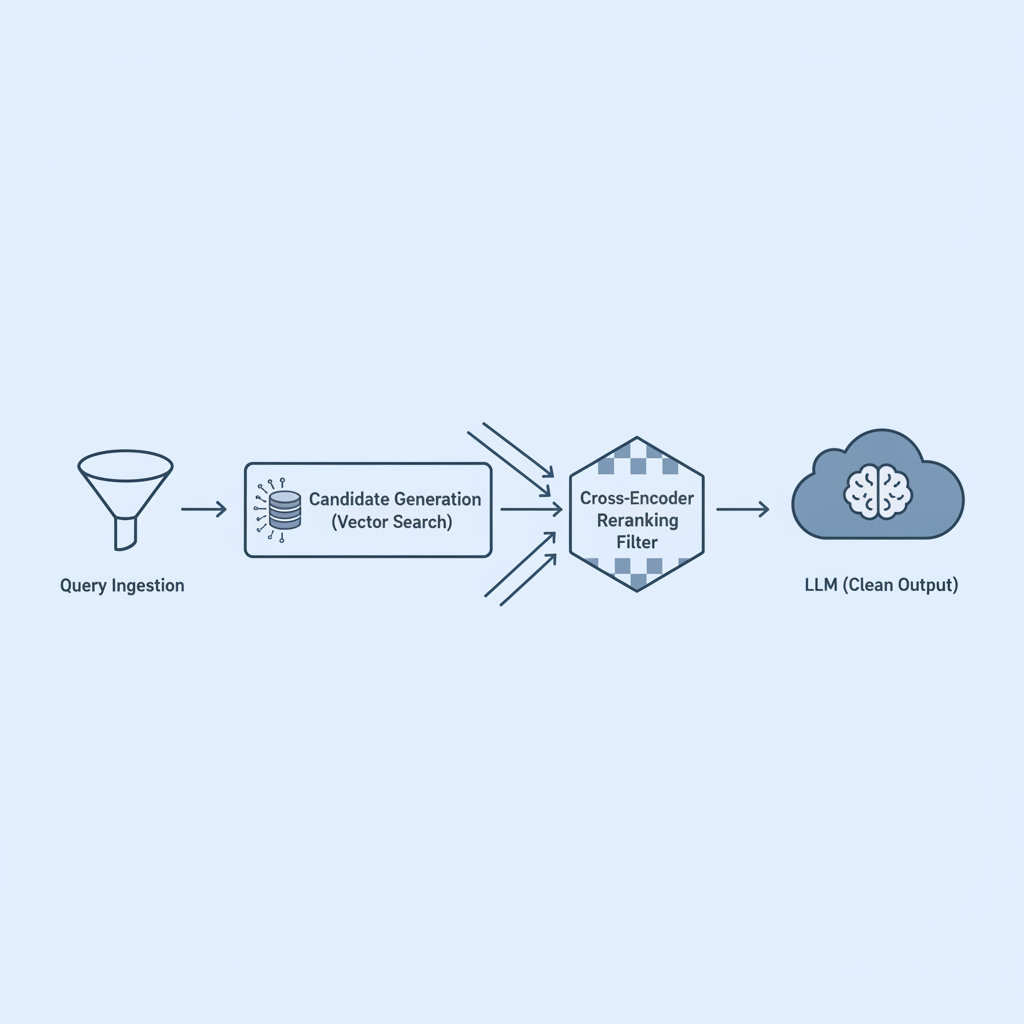
You implement reranking in a retrieval-augmented generation pipeline by introducing a lightweight second stage that scores a broad pool of candidate chunks using a cross-encoder model. Rather than passing twenty unverified vector matches straight to your generation model, you retrieve thirty to fifty candidates using fast vector search, rerank them against the raw query, and pass only the top three to five verified chunks to your language model.
Standard vector search relies on bi-encoder embeddings that compress complex chunk semantics into a single vector. While dense vector retrieval is fast, it frequently misses nuanced keyword matches, negative constraints, and domain-specific terminology. Adding a reranker fixes these precision failures, but if you do not design the pipeline carefully, cross-encoder inference can add several hundred milliseconds of unwanted latency to every user request.
By Jim Vernon, Editor, AI Intelligence International · Published 15 October 2026 · Reviewed against our editorial standards · About the author
What are the key takeaways?
- Two-stage retrieval separates broad recall via vector search from high-precision relevance scoring via cross-encoders.
- Reranking cuts downstream LLM generation costs by reducing the volume of context tokens needed in the final prompt.
- Cross-encoder scoring considers query and document tokens simultaneously, catching exact keyword matches that dense vectors overlook.
- Dynamic thresholding based on reranker confidence scores lets your application decline to answer rather than hallucinating over irrelevant context.
What does this article cover?
| Question answered | How Do You Implement Reranking in RAG Pipelines Without Ballooning Latency? |
|---|---|
| Topic | Developer & Tech |
| Reading time | About 7 minutes (1,601 words) |
| Written by | Jim Vernon, Editor, AI Intelligence International |
| Published | 15 October 2026 |
| Last updated | 15 October 2026 |
Why Does Standard Vector Search Fail Without Reranking?
Dense vector retrieval converts your documents and incoming queries into high-dimensional vectors, calculating cosine similarity to locate relevant context. While this process is exceptionally fast, it relies on bi-encoder models that compress the semantic meaning of an entire chunk into a single fixed vector. During that compression, subtle distinctions disappear. Vector embeddings often struggle with numerical queries, exact code syntax, specific identifiers, and queries containing negation, such as asking for policies that do not apply to contractors.
When you rely solely on vector similarity, you must widen your retrieval window to ensure the correct context is present, often fetching fifteen or twenty chunks per query. This practice degrades prompt precision, floods your language model with irrelevant noise, and increases the likelihood of hallucination. A reranker solves this problem by taking the query and each individual chunk together, processing them simultaneously through full cross-attention to determine true semantic relevance.
How Does a Two-Stage Retrieval Pipeline Work in Practice?
A production two-stage retrieval pipeline combines speed at the base and precision at the top. In stage one, you execute a high-recall, low-latency search across your database. You can use standard approximate nearest-neighbour vector search, BM25 keyword search, or a hybrid combination of both. The goal of stage one is not perfection; it is recall. You fetch between thirty and fifty candidate chunks in twenty to forty milliseconds, accepting that half of them might be irrelevant.
In stage two, your reranker receives the user query alongside the candidate list. Unlike the vector index, the reranker is a cross-encoder that evaluates the query and chunk side by side. It outputs a normalised relevance score for each pair. You sort the candidates by score, discard any chunk that fails to meet a predetermined confidence threshold, and slice the top three to five chunks. These high-precision chunks form the final context passed to your generation model.
Which Reranking Model Should You Choose for Production?
Choosing the right reranking model depends on whether your infrastructure favours hosted convenience or self-hosted control. Commercial hosted reranking endpoints, such as Cohere Rerank or Voyage AI, deliver state-of-the-art accuracy across multilingual datasets without requiring dedicated GPU infrastructure. They integrate via straightforward API calls, making them ideal when engineering time is constrained and your compliance boundary permits sending chunk text to an external provider.
If you require strict on-premises data privacy or sub-fifty-millisecond response times, self-hosted cross-encoders are the better architectural choice. Lightweight models such as BAAI bge-reranker-base or cross-encoder ms-marco-MiniLM-L-6-v2 can be deployed on cost-effective cloud instances with basic inference acceleration like ONNX Runtime or TensorRT. A quantised MiniLM model running on a modest GPU can score fifty candidates in under thirty milliseconds, keeping total system latency well within real-time interactive thresholds.
What Does the Latency and Cost Math Look Like at Scale?
Adding a reranker introduces a computational step, but it often lowers overall system operating costs by reducing token consumption in the generation stage. Consider a system processing 10,000 queries per day. Your retrieval pipeline fetches candidates averaging 200 tokens each, alongside a 50-token user query. If you do not rerank, you might need to pass 20 chunks to the generation model to ensure high recall, requiring 4,000 context tokens per query. Across 10,000 queries, that equals 40,000,000 input tokens daily. At a generation input rate of £2.50 per 1,000,000 tokens, daily context costs run to £100.00.
Now consider the two-stage pipeline. You retrieve 50 candidates in stage one and pass them to a reranker, selecting only the top 5 chunks for generation. Reranking 50 documents costs roughly £0.002 per query, or £20.00 daily across 10,000 queries. However, your generation prompt now contains only 5 chunks, or 1,000 tokens. Daily context tokens drop from 40,000,000 to 10,000,000, reducing daily prompt spend from £100.00 to £25.00. Adding the £20.00 reranking cost yields a total daily cost of £45.00, producing a net daily saving of £55.00, or £1,650.00 every thirty days, whilst delivering cleaner context to your users.
How Do You Tune Top-K and Score Thresholds to Maximise Relevance?
The performance of your reranked pipeline depends directly on two operational parameters: candidate depth and relevance score cut-offs. Setting your initial candidate pool too small, such as retrieving only ten chunks from vector search, starves the reranker of relevant material if dense retrieval ranked the correct chunk at position twelve. Setting it too high, above seventy chunks, causes cross-encoder latency to grow linearly without providing meaningful recall improvements. For most enterprise document stores, thirty to fifty initial candidates offer the ideal balance.
You must also establish an explicit relevance score cut-off rather than blindly returning a fixed number of documents. High-quality rerankers output calibrated scores between zero and one. If a user asks a question that your knowledge base cannot answer, all fifty candidate chunks might return scores below 0.35. By enforcing a threshold, your system can drop low-scoring chunks entirely. If no chunks pass the threshold, the application can route the query to a fallback message or refuse to answer, directly eliminating ungrounded hallucinations.
How Can You Cache and Batch Rerank Requests Under Load?
Under concurrent production traffic, unmanaged cross-encoder inference can quickly saturate your application servers. The first defence is aggressive semantic caching on common retrieval queries. If multiple users ask variations of identical policy or onboarding questions, caching the reranked chunk identifiers for twenty-four hours eliminates both the retrieval database query and the cross-encoder inference entirely.
For real-time traffic spikes, implement dynamic batching on your inference server. Cross-encoders process input pairs efficiently when packed into uniform matrix operations. Rather than processing each chunk sequentially, your pipeline should assemble the query-chunk pairs into a single batch request sent to your inference container. If network latency between your application and the reranker is a bottleneck, colocate your reranker service inside the same private virtual cloud cluster as your primary application backend.
How Do You Evaluate Whether Reranking Actually Improves Generation?
Never deploy a reranker to production without empirical evaluation on your specific domain data. Build a gold-standard evaluation set consisting of at least one hundred representative queries paired with human-verified relevant chunks. Measure Mean Reciprocal Rank (MRR) and Hit Rate at positions one, three, and five both before and after applying the reranker. A successful reranker deployment should lift Hit Rate at position three by at least fifteen to twenty-five percentage points over raw vector search.
Beyond retrieval metrics, assess downstream generation quality using groundedness and answer correctness evaluations. When context precision improves, language models produce fewer tangential statements and cite sources more accurately. Monitor your user feedback telemetry, particularly thumbs-down rates and answer regeneration requests. A steady drop in user-initiated prompt retries is the most reliable production indicator that your reranker is serving relevant context.
What do people ask most about this?
How does a reranker differ from hybrid search?
Hybrid search combines dense vector retrieval and sparse keyword search, such as BM25, at the retrieval layer using reciprocal rank fusion. While hybrid search improves broad recall by capturing both exact terms and conceptual matches, it still scores documents independently without deep cross-attention. A reranker operates after hybrid search, taking the combined candidate list and evaluating the full contextual interaction between query tokens and document tokens. In modern architectures, combining hybrid search in stage one with a cross-encoder reranker in stage two yields the highest retrieval precision.
What is the typical latency added by a reranking step?
The latency of a reranking step depends on the number of candidates and your chosen model architecture. A lightweight cross-encoder such as ms-marco-MiniLM-L-6-v2 running on a dedicated cloud GPU typically scores thirty to forty chunks in fifteen to thirty milliseconds. Hosted API rerankers generally add between sixty and one hundred and fifty milliseconds, which includes network round-trip time. You can minimise the perceived latency impact by streaming the generated answer to the user as soon as the language model receives the filtered context.
Can I use an LLM directly as a reranker?
You can prompt a general-purpose language model to score or reorder candidate documents, but doing so is rarely practical in production. Using a frontier language model for reranking introduces substantial latency, often exceeding one to two seconds, and consumes significant token budgets. Dedicated cross-encoder models are trained specifically for sequence classification, making them vastly faster, significantly cheaper, and more deterministic than prompting a generative model to sort text snippets.
How many candidate chunks should I pass to the reranker?
For most enterprise search and question-answering systems, retrieving thirty to fifty candidates from stage one provides the optimal trade-off between recall and latency. Passing fewer than twenty candidates risks leaving out relevant chunks that ranked poorly in vector space. Passing more than seventy candidates yields diminishing recall gains while causing cross-encoder scoring times and memory consumption to rise linearly. Start with forty candidates and benchmark your retrieval hit rate before adjusting.
How was this article researched?
This article is written and maintained by Jim Vernon, Editor at AI Intelligence International. Figures and claims are drawn from the calculators and models published on this site, from vendor documentation current at the time of writing, and from first-hand testing of the tools described. Every article is reviewed against our editorial standards before publication and re-checked whenever the underlying tools or pricing change.