Developer & Tech
How Do You Implement Circuit Breakers and Budgets for Production AI Agents?
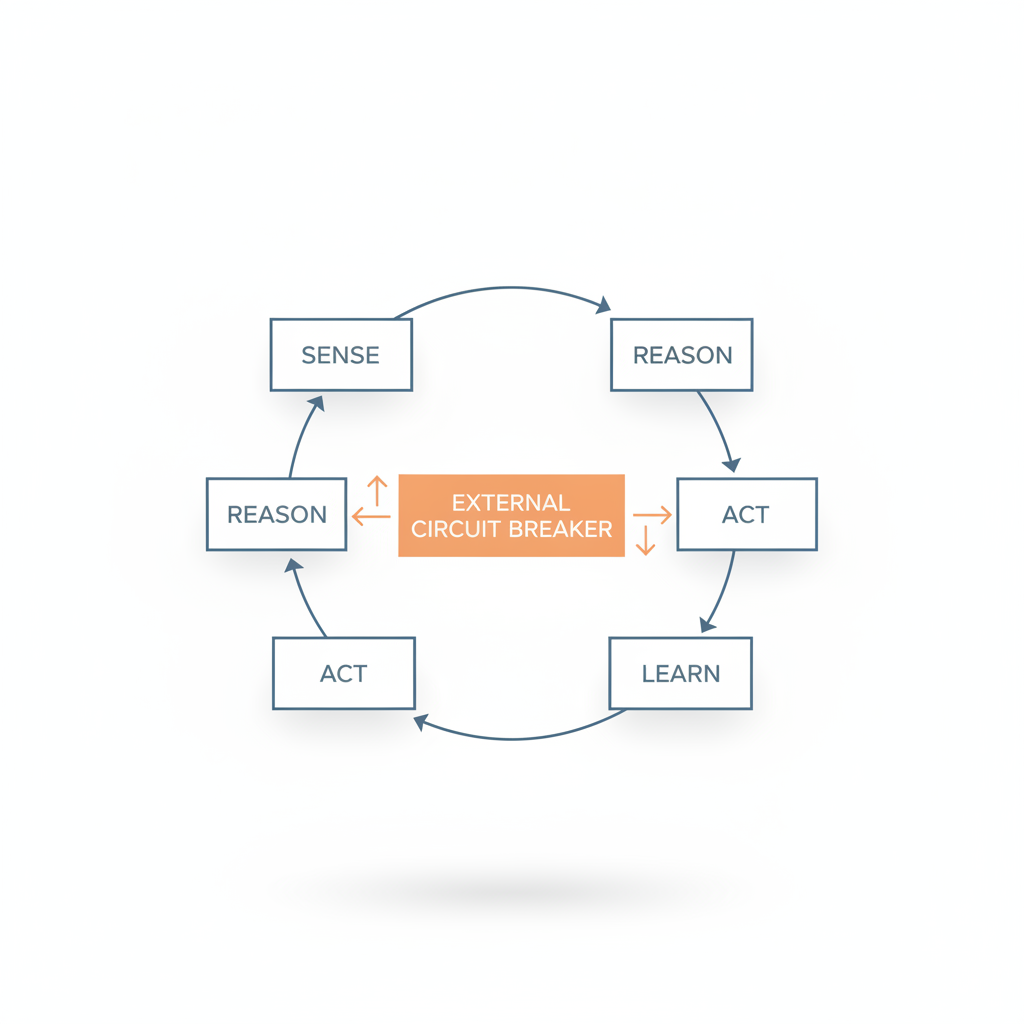
You implement circuit breakers for production AI agents by enforcing deterministic, stateful limits outside the model itself. Wrap every agent execution loop in an external orchestrator that tracks cumulative input and output tokens, total wall-clock execution time, consecutive tool failures, and absolute step counts. When any single threshold is breached, the orchestrator immediately revokes execution privileges, saves the intermediate state, returns a graceful failure, and alerts the monitoring system before financial or compute waste compounds.
Autonomous agents rely on non-deterministic feedback loops to inspect inputs, select tools, and iterate towards a goal. When models hallucinate non-existent arguments, misread API error payloads, or oscillate between complementary tools, an unconstrained loop can run until provider timeouts or credit exhaustion. Hard software guardrails must sit entirely outside the LLM context window to prevent catastrophic cloud bills and system degradation.
By Jim Vernon, Editor, AI Intelligence International · Published 23 October 2026 · Reviewed against our editorial standards · About the author
What are the key takeaways?
- Hard execution boundaries must be enforced by application code rather than prompt instructions or system directives.
- Tracking consecutive tool execution errors identifies failing loops far faster than aggregate token caps alone.
- Stateful execution checkpoints let operators resume interrupted runs without reprocessing foundational prompt tokens.
- A multi-layered circuit breaker evaluates token limits, iteration steps, wall-clock duration, and cost ceilings concurrently.
What does this article cover?
| Question answered | How Do You Implement Circuit Breakers and Budgets for Production AI Agents? |
|---|---|
| Topic | Developer & Tech |
| Reading time | About 8 minutes (1,798 words) |
| Written by | Jim Vernon, Editor, AI Intelligence International |
| Published | 23 October 2026 |
| Last updated | 23 October 2026 |
Why do autonomous AI agents run into catastrophic loops?
Autonomous agents operate by feeding model completions back into subsequent prompts as tool results or thought traces. This recursive architecture means that any subtle failure in tool schema parsing or environmental state can trigger an infinite oscillation. For example, if a model queries a customer database with an unexpected date format and receives a validation error, it may attempt the exact query repeatedly or oscillate between two alternative query endpoints without resolving the underlying format error.
Prompt engineering alone cannot solve this behaviour because models experience context amnesia regarding their own repetitive failures once conversation histories stretch. If the system prompt instructs the agent to retry until it finds a valid answer, the agent interprets that directive literally. Without deterministic, application-level counters operating outside the model context, the agent will burn inference tokens against the provider API until the host server hits its network timeout or your credit line runs dry.
Furthermore, multi-agent frameworks often amplify these loops. When one agent delegates an ambiguous subtask to a secondary agent, the secondary agent may return an unparsable response. The coordinating agent will often re-prompt the subordinate with identical inputs, generating a compounding cascade of API requests that increases your infrastructure costs exponentially within minutes.
What specific limits should an agent circuit breaker enforce?
A resilient production circuit breaker must monitor four distinct resource dimensions concurrently on every loop iteration. The first dimension is an absolute iteration step limit, capping the total number of reasoning and tool-call cycles to a predefined maximum, typically between five and ten steps for common enterprise tasks. If an agent cannot resolve the request within eight deliberate tool executions, additional iterations rarely produce a correct outcome.
The second dimension is a cumulative token budget that tracks both prompt and completion tokens consumed across the entire lifecycle of a single user request. This ceiling protects your balance against runaway context expansion, which happens when an agent repeatedly dumps massive payloads into its conversation history. The third dimension is a strict wall-clock timeout that cuts execution if asynchronous external APIs hang or introduce excessive latency.
The fourth and most critical metric is a consecutive tool error threshold. While an agent should be permitted one or two retries to recover from a transient formatting issue or network blip, three identical or consecutive tool failures indicate a systemic roadblock. Your orchestrator should trigger an immediate breaker trip as soon as this threshold is met, rather than allowing the model to spend remaining token reserves attempting impossible repairs.
How do you calculate the financial cost of unmonitored agent failures?
To understand the necessity of programmatic circuit breakers, consider an automated customer inquiry triage agent deployed across an e-commerce platform processing 10,000 tasks per day. Assume the agent uses a frontier model priced at £2.00 per million input tokens and £8.00 per million output tokens. In normal operation, each resolved ticket requires an average of 3,000 input tokens and 500 output tokens across 3 iterations, costing £0.01 per run, or £100.00 daily across the entire baseline workload.
Now assume that an external shipping API updates its response format without notice, causing a 4 percent failure rate where the agent enters an unhandled retry loop. Without circuit breakers, each looping agent runs until hitting a 15-minute platform timeout, executing 30 iterations while accumulating historical context. Each failed task consumes an average of 45,000 input tokens and 6,000 output tokens, costing £0.138 per failed run. Across 400 failed tasks daily, these runaway loops waste £55.20 every single day, representing a 55 percent cost inflation on the entire pipeline.
With a deterministic circuit breaker configured to trip after 6 iterations, 15,000 cumulative tokens, or 3 consecutive tool errors, the average failed run is terminated after consuming only 8,000 input tokens and 1,200 output tokens. This restricts the cost of each failed run to £0.0256. Across the same 400 failures, the daily waste drops from £55.20 to £10.24, saving £44.96 daily or £1,348.80 per month while preserving downstream server availability.
Where should breaker state be stored in distributed systems?
In a scalable production architecture, agent execution workers are stateless and distributed across serverless functions or container clusters. Storing loop counters in local process memory creates dangerous blind spots if a single agent task spans multiple worker handoffs or asynchronous background jobs. Breaker state must reside in an ultra-low-latency, centralised data store such as Redis or an in-memory key-value cache located in the same cloud region as your compute nodes.
Each user session or background job must be assigned a unique task run identifier. Before any model invocation or tool call occurs, the execution harness must read the current state object from the cache. This object contains cumulative token tallies, elapsed execution milliseconds, total loop count, and consecutive failure counts. Atomic increment operations allow workers to update metrics safely without race conditions when tools execute in parallel.
If the cached metrics exceed any configured threshold, the harness immediately halts execution before sending another HTTP request to the model provider. Storing this state externally also allows operational teams to inspect live executions, force-kill hung agents from an administrative dashboard, and aggregate real-time breaker metrics across the entire enterprise cluster.
How should an agent fail gracefully when a circuit breaker trips?
Tripping a circuit breaker must never result in an unhandled 500 error or a blank response to the end user. When an agent exceeds its operational boundaries, the orchestration harness should catch the boundary violation, log the complete trace for engineering evaluation, and trigger a predefined fallback routine. The fallback depends on whether the workflow is user-facing or an internal asynchronous pipeline.
For customer-facing systems, the orchestrator should return a transparent, polite message explaining that the request requires human review, automatically routing the accumulated conversation history and partial findings to a customer service queue. Because the breaker preserves the execution state, the human agent can review the specific tool payload that caused the loop rather than asking the customer to repeat their problem from scratch.
For asynchronous internal workflows, such as automated lead scoring or data extraction, the system should push the job to a dead-letter queue. The partial state should be written to permanent storage alongside a structured error code, such as ERR_CONSECUTIVE_TOOL_FAILURES or ERR_TOKEN_BUDGET_EXCEEDED. This enables automated alerting and lets developers replay the exact execution trace locally using mock data to diagnose why the agent lost its path.
How do you test and calibrate circuit breaker thresholds?
Setting circuit breaker thresholds too aggressively results in false positives, aborting complex reasoning tasks that simply required an extra step. Setting them too loose exposes your organisation to unnecessary cost and latency. Calibrating these boundaries requires rigorous offline evaluation using historical execution traces that represent both simple queries and legitimately difficult multi-step workflows.
Begin by running your agent across a benchmark suite of 100 to 200 representative tasks while logging complete token, time, and tool metrics with limits disabled. Plot the distribution of successful runs to establish your P95 and P99 baselines for iteration counts and token consumption. Set your initial hard limits roughly 20 to 30 percent above your P99 successful baseline. If 99 percent of successful runs complete within 6 iterations and 12,000 tokens, a budget of 8 iterations and 16,000 tokens provides a safe buffer while halting outliers.
You must also implement deliberate chaos tests in staging environments. Inject synthetic network latency, simulate corrupted database responses, and introduce invalid tool parameters to verify that the circuit breaker trips exactly when expected. Automated end-to-end integration tests should verify that breaker events correctly emit metrics, increment alerting counters, and return standard fallback payloads without leaking stack traces or unparsed model errors.
What do people ask most about this?
What is the difference between a retry policy and a circuit breaker?
A retry policy is designed to handle transient, recoverable faults by automatically re-executing a failed operation, often using exponential backoff to avoid overwhelming upstream services. In contrast, a circuit breaker is an architectural safeguard that stops execution entirely when failures exceed a set threshold or pattern. Retries assume the operation will succeed if attempted again, whereas a circuit breaker assumes that repeated failures indicate a deeper systemic problem that will merely waste computational budget and tokens if allowed to continue.
Should token limits be calculated on raw tokens or monetary cost?
Production systems should track both, but token count is the primary metric for operational safety because it maps directly to provider context windows and network payload sizes. Tracking input and output tokens separately allows your orchestrator to detect runaway generation loops, where a model outputs repetitive gibberish, versus context bloat, where an agent loads unnecessarily large documents into the prompt. Translating these token counts into monetary cost in real time ensures financial budgets are respected, especially when using models with asymmetrical input and output pricing tiers.
Can prompt engineering alone stop an agent from infinite looping?
Prompt engineering cannot reliably prevent infinite loops in production environments. While system prompts can instruct models to give up after several failed attempts, models struggle to accurately count their own iterations once context windows grow long and messy. Furthermore, if an external API returns an unexpected error format, the model may experience an instruction conflict between finding the answer and reporting the error, causing it to ignore negative constraints. Programmatic, external circuit breakers in your application code are the only foolproof defence.
How do circuit breakers handle parallel tool calls in modern models?
When an agent uses parallel tool calling to execute multiple functions simultaneously, the orchestrator must aggregate the resource consumption of all concurrent operations before allowing the next model turn. If the model invokes four database queries at once, the harness must run each query within an individual timeout, count all resulting errors, and sum the returned payload sizes. If two of the four parallel calls fail, the consecutive failure counter increases accordingly, and if the total payload exceeds the input token buffer, the breaker trips before the next prompt.
How was this article researched?
This article is written and maintained by Jim Vernon, Editor at AI Intelligence International. Figures and claims are drawn from the calculators and models published on this site, from vendor documentation current at the time of writing, and from first-hand testing of the tools described. Every article is reviewed against our editorial standards before publication and re-checked whenever the underlying tools or pricing change.