Developer & Tech
How Do You Handle Streaming Disconnections in Production LLM Apps?
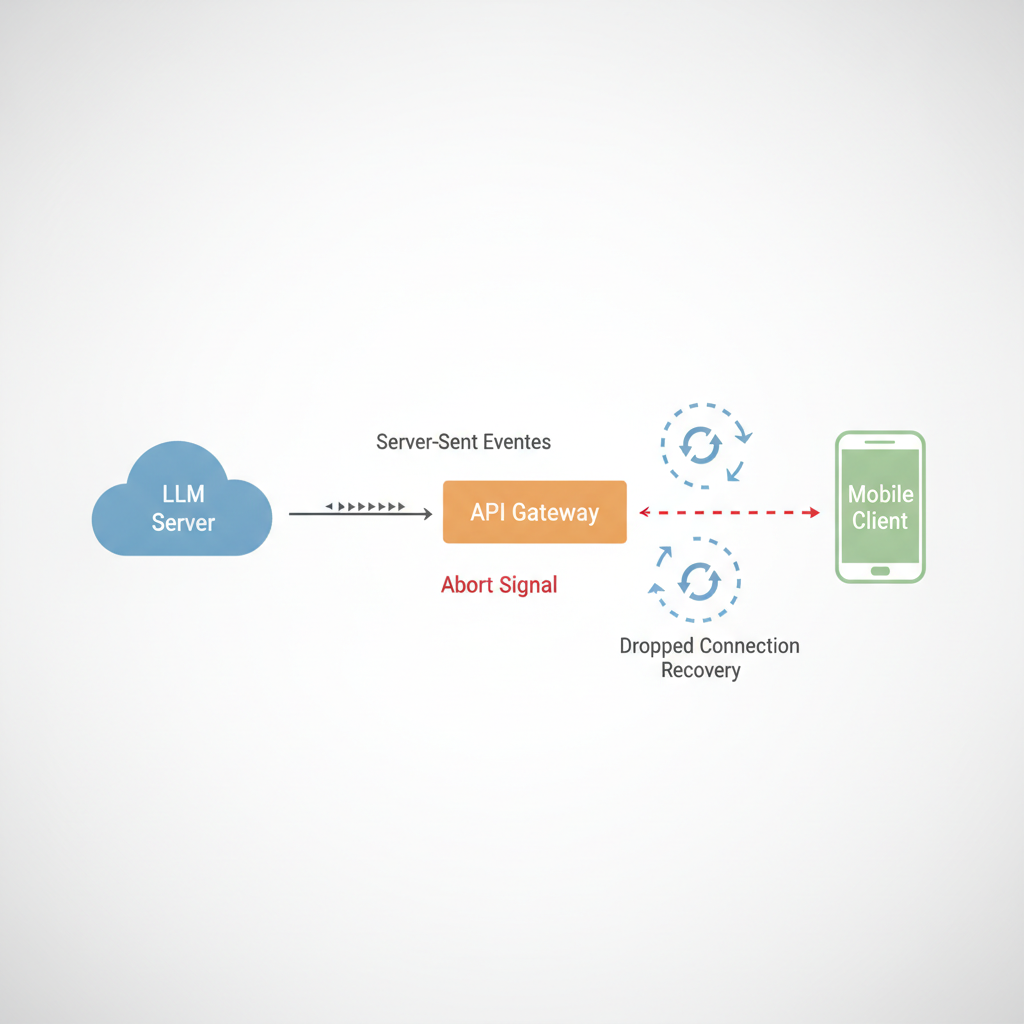
You handle streaming disconnections in production LLM applications by tying client abort signals directly to upstream provider requests, persisting partial responses with explicit interrupted flags, and reconciling consumed tokens against actual provider invoices. When a client drops off, your server must immediately cancel the generation socket, write the partial completion to your message history, and inform downstream billing workers rather than allowing the model to complete its output invisibly.
Real-time streaming through Server-Sent Events (SSE) or WebSockets improves perceived user latency dramatically, but it introduces state divergence when mobile networks switch towers, users close browser tabs, or client buffers back up. Failing to manage disconnected sockets wastes expensive generation tokens, corrupts conversational memory, and degrades user trust when half-rendered messages vanish upon browser refresh.
By Jim Vernon, Editor, AI Intelligence International · Published 26 October 2026 · Reviewed against our editorial standards · About the author
What are the key takeaways?
- Always pass an AbortController signal from the client HTTP request directly through your server to the upstream foundation model SDK.
- Store partial completions in your database marked with an interrupted status rather than discarding the turn or corrupting context memory.
- Uncancelled upstream streams burn thousands of unrendered output tokens every week that you must still pay your provider for.
- Implement sequence numbering on streamed message chunks so the front end can detect packet loss and trigger structured reconnection.
What does this article cover?
| Question answered | How Do You Handle Streaming Disconnections in Production LLM Apps? |
|---|---|
| Topic | Developer & Tech |
| Reading time | About 8 minutes (1,801 words) |
| Written by | Jim Vernon, Editor, AI Intelligence International |
| Published | 26 October 2026 |
| Last updated | 26 October 2026 |
Why do streaming connections fail in production LLM applications?
Streaming LLM responses rely on persistent HTTP connections using Server-Sent Events or duplex WebSockets. Unlike standard request-response cycles where the entire payload returns in a single round trip, an LLM stream can remain open for thirty to ninety seconds while the foundation model outputs hundreds of tokens. During this extended window, real-world network conditions frequently interrupt the transport pipe. Mobile clients switch between Wi-Fi and cellular radios, corporate firewalls sever idle keep-alive connections, and users routinely navigate away or close laptop lids while an answer is halfway through generating.
Beyond pure physical network breaks, application-level friction causes frequent dropouts. When a client browser executes intensive rendering on the main thread, the incoming event stream buffer can overflow, leading to socket starvation and browser-initiated resets. If your server infrastructure does not actively monitor socket health with bi-directional heartbeats, the server assumes the client is still listening while the client has already abandoned the session. This disconnect between client state and server processing creates phantom workloads that degrade platform stability.
How do you detect and cancel abandoned upstream LLM requests?
The foundational rule of streaming engineering is immediate signal propagation. When a client connects to your streaming endpoint, your web application runtime creates an incoming request object bound to an underlying network socket. If the user closes the tab or hits a stop button, the browser terminates the TCP connection, triggering a close event or abort signal on your HTTP framework. Your backend server must capture this client termination and propagate it directly to the HTTP client that is communicating with OpenAI, Anthropic, or your self-hosted inference cluster.
In Node.js, Python FastAPI, or Go services, you achieve this by passing an AbortSignal or context cancellation token directly into the provider SDK call. When the client disconnects, your route handler trips the cancellation context, which instantly terminates the outbound TLS connection to the model provider. Without this explicit linkage, the upstream provider will continue generating tokens until completion, deducting usage credits and consuming compute for tokens that no human will ever see. Your reverse proxy, whether Nginx, Cloudflare, or AWS ALB, must also be configured with appropriate disconnect propagation settings so upstream worker processes receive socket hangup notifications immediately.
How should your database handle interrupted and partial responses?
When a generation cuts off midway, your persistent data layer faces a consistency dilemma. If you discard the partial message entirely, the user sees text disappear after refreshing their screen, which feels broken and disorienting. If you save the half-completed text as a normal assistant turn, future prompts will include malformed sentences, broken markdown tables, or open JSON tags in their context window, which inevitably triggers hallucinated continuations or schema parsing failures on subsequent turns.
The robust architectural pattern is to store the partial response alongside an explicit generation status column set to interrupted or cancelled. In addition, your persistence worker should append a clean syntactic conclusion, such as closing dangling code blocks or quotation marks, or cleanly flagging the text as truncated. When assembling conversational history for subsequent turns, your prompt compiler can either omit the truncated turn, instruct the model that the previous thought was cut off by user action, or offer the user a single-click button to resume generation from the exact point of interruption.
What is the financial cost of uncancelled streaming connections?
Failing to cancel orphaned streams creates substantial financial waste that grows linearly with your active user base. Consider a mid-sized B2B application serving 50,000 monthly active users who generate a collective 400,000 streaming assistant responses each month. In high-interactivity applications, production log analysis typically reveals that roughly 3.5 percent of streaming interactions terminate prematurely due to user navigation, mobile disconnects, or users manually clicking the stop button after reading enough of the initial draft. This results in exactly 14,000 interrupted generation requests every single month.
Assume the average configured model completion is 1,200 output tokens, but users disconnect or cancel after receiving just 200 tokens. If your backend fails to propagate the abort signal to your provider, the model will proceed to generate the remaining 1,000 output tokens in the background on every single dropped connection. Across 14,000 abandoned calls, your infrastructure unnecessarily generates 14,000,000 wasted output tokens per month. At a standard commercial price of $15.00 per million output tokens for high-capability models, this failure burns $210.00 each month, or $2,520.00 annually, in raw provider costs. If you run complex reasoning models billed at $60.00 per million output tokens, that same oversight burns $840.00 monthly, or $10,080.00 every year, for completely discarded computation.
How do you design front-end UI states for interrupted token streams?
Handling dropped connections gracefully requires deliberate user interface design that prevents confusing visual states. When an SSE stream abruptly stalls, a naive interface leaves a pulsing cursor blinking indefinitely, forcing the user to guess whether the model is thinking or dead. Your client-side streaming client must implement an inactivity timer. If no new token chunk arrives within six to eight seconds, the client should transition from a streaming state to an interrupted state, replacing the loading animation with clear status messaging and an actionable retry action.
Furthermore, your front-end rendering pipeline should sanitise partial markdown before displaying it. If a stream disconnects while delivering an unclosed code block, bold tag, or HTML element, standard markdown parsers can break layout styling across the rest of the application dashboard. Use resilient incremental parsers that dynamically close unclosed syntax trees in memory during rendering. Provide clear visual cues that distinguish between a system-level network disconnection and an intentional user-initiated cancellation, giving the end user full clarity on what occurred.
How do you implement resumable streaming for high-latency generations?
For complex technical workflows involving long-form content generation or multi-agent workflows, dropping a stream after sixty seconds of waiting is an unacceptable user experience. Resumable streaming solves this by decoupling token generation from direct client consumption. Instead of streaming directly from the model provider to the client socket, your server ingests the upstream chunks, assigns an incrementing index sequence to each chunk, and buffers them in an ephemeral cache such as Redis before pushing them down the client SSE pipe.
If the client socket drops due to an unstable Wi-Fi connection, the client reconnects using an HTTP header such as Last-Event-ID containing the index of the final chunk it successfully rendered. Your server checks Redis, replays the missed chunks from that sequence index onward, and continues streaming live tokens without restarting the generation from scratch. If the generation completes while the client is still offline, the completed text is moved to permanent storage, allowing the user to view the full result upon returning without paying for a second generation.
What telemetry must you capture to diagnose streaming drop-off rates?
You cannot optimise streaming resilience without granular operational telemetry. Standard web analytics aggregate HTTP status codes, but an interrupted SSE stream often returns an initial HTTP 200 OK header before failing twenty seconds later. To capture real streaming performance, your backend logging pipeline must track time-to-first-token, stream duration in milliseconds, total tokens generated upstream versus total tokens delivered downstream, and the exact termination reason code.
Categorise disconnect terminations into three distinct buckets: user aborts, server runtime timeouts, and unexpected client transport drops. If your telemetry indicates that unexpected client drops spike on specific cellular subnets or after exactly thirty seconds, you have likely identified an intermediate cloud proxy terminating quiet sockets. Monitoring the delta between upstream provider billing tokens and verified downstream received tokens provides an immediate visual health check on your cancellation pipelines, confirming that your infrastructure stops paying the moment users stop listening.
What do people ask most about this?
What is the difference between Server-Sent Events and WebSockets for LLM streaming?
Server-Sent Events are unidirectional HTTP channels where the server pushes text chunks down a single connection, making them lightweight, firewall-friendly, and naturally aligned with native HTTP multiplexing. WebSockets provide a full-duplex persistent TCP connection enabling simultaneous two-way messaging. For standard text-based LLM applications, Server-Sent Events are generally preferred because LLM interactions are inherently unidirectional during the generation phase. WebSockets add unnecessary state complexity unless you require real-time bi-directional voice streaming, low-latency client audio chunk uploads, or active multi-user collaborative canvas editing.
Does closing an HTTP connection automatically stop the model from generating?
No, closing an HTTP connection between client and server does not automatically stop the upstream foundation model from generating tokens. When a browser closes an SSE connection, the client socket closes, but your application server will continue processing the upstream model response unless your application code explicitly listens for socket termination events and passes an active cancellation signal to the provider SDK. Without programmed cancellation logic, the LLM provider will finish generating the entire response, charge your API account for all requested tokens, and waste backend server memory.
How should token usage be tracked and billed if a stream is cancelled halfway through?
You should bill users based strictly on the reconciled token usage reported by your upstream provider or internal tokenizer at the moment cancellation completes. When an upstream generation is terminated via an abort signal, providers like OpenAI and Anthropic calculate usage up to the point the cancellation was processed and return partial billing data in their final response payload. Your database should log this verified billable token count against the user quota, even if only a fraction of those tokens reached the client screen before the connection severed.
Why do long streaming responses cut off after exactly thirty or sixty seconds?
Streams that consistently sever at clean thirty or sixty-second boundaries are almost always caused by proxy timeouts rather than LLM application errors. Edge proxies, reverse proxies such as Nginx, API gateways, and load balancers like Cloudflare or AWS ALB have default idle read timeouts that terminate connections if no raw data passes through for a configured duration. If your LLM pauses for extended reasoning periods between chunks, the proxy assumes the socket is dead. You can prevent this by increasing proxy read timeouts and transmitting empty periodic SSE comment lines to keep connections open.
How was this article researched?
This article is written and maintained by Jim Vernon, Editor at AI Intelligence International. Figures and claims are drawn from the calculators and models published on this site, from vendor documentation current at the time of writing, and from first-hand testing of the tools described. Every article is reviewed against our editorial standards before publication and re-checked whenever the underlying tools or pricing change.