Tools & Buying
Should You Pay Annually or Monthly for AI Subscriptions?
You should pay monthly for almost all commercial AI applications and reserve annual commitments strictly for core infrastructure with substantial data lock-in. Because underlying language models advance rapidly while token costs fall, the typical twenty percent discount offered on an annual contract rarely offsets the financial risk of paying for superseded technology or abandoned seats before twelve months pass.
Enterprise software buyers spent decades treating annual contracts as the standard mechanism for securing software discounts. In traditional software categories like accounting or human resources, workflows remain predictable for years at a time. Generative AI tools behave differently: a utility that seems indispensable in January can easily become obsolete by June because of a platform update from a frontier lab, a cheaper open-source alternative, or shifting internal requirements.
By Jim Vernon, Editor, AI Intelligence International · Published 17 September 2026 · Reviewed against our editorial standards · About the author
What are the key takeaways?
- Annual discounts between fifteen and twenty-five percent rarely cover the depreciation risk created by rapid frontier model upgrades.
- The standard break-even point on a twenty percent annual discount requires ten consecutive months of full utilisation to deliver any net savings.
- Pay on a rolling monthly basis for at least ninety days to verify whether regular team usage survives the initial phase of novelty.
- Reserve annual software agreements for systems that store unique operational context, custom embeddings, or deep integration plumbing.
What does this article cover?
| Question answered | Should You Pay Annually or Monthly for AI Subscriptions? |
|---|---|
| Topic | Tools & Buying |
| Reading time | About 8 minutes (1,661 words) |
| Written by | Jim Vernon, Editor, AI Intelligence International |
| Published | 17 September 2026 |
| Last updated | 17 September 2026 |
Why is paying annually for AI different from traditional software?
When you purchase an annual licence for conventional software such as spreadsheets, issue trackers, or payroll systems, the underlying technology remains functionally stable. The feature set you evaluate during procurement is fundamentally the same feature set your team uses ten months later. Vendor capabilities move incrementally, meaning that a long-term commitment carries little risk of sudden architectural obsolescence or market-driven price collapse.
Generative AI applications exist in a volatile technological environment where the cost of intelligence decreases by significant margins every year. Many commercial AI tools operate as proprietary interfaces layered on top of external foundation models. When foundation model providers reduce API pricing or launch capabilities that replicate third-party wrapper features, standalone software tools often struggle to justify their subscription costs. Committing to twelve months upfront removes your flexibility to adopt superior tools or benefit from price drops.
There is also an internal adoption risk that traditional procurement teams underestimate. When teams encounter new AI capabilities, enthusiasm runs high during the trial period. However, unless the tool integrates directly into daily habits and existing software pipelines, active engagement tends to decay within six to eight weeks. An annual subscription locks you into paying for unassigned or idle seats long after novelty has faded.
How do you calculate the true break-even point of an annual discount?
Software vendors typically offer a discount between fifteen and twenty-five percent to incentivise annual commitments upfront. On paper, receiving two months free appears financially responsible. In practice, the arithmetic only works in your favour if every paid seat maintains full, active utility across nearly the entire duration of the twelve-month billing cycle.
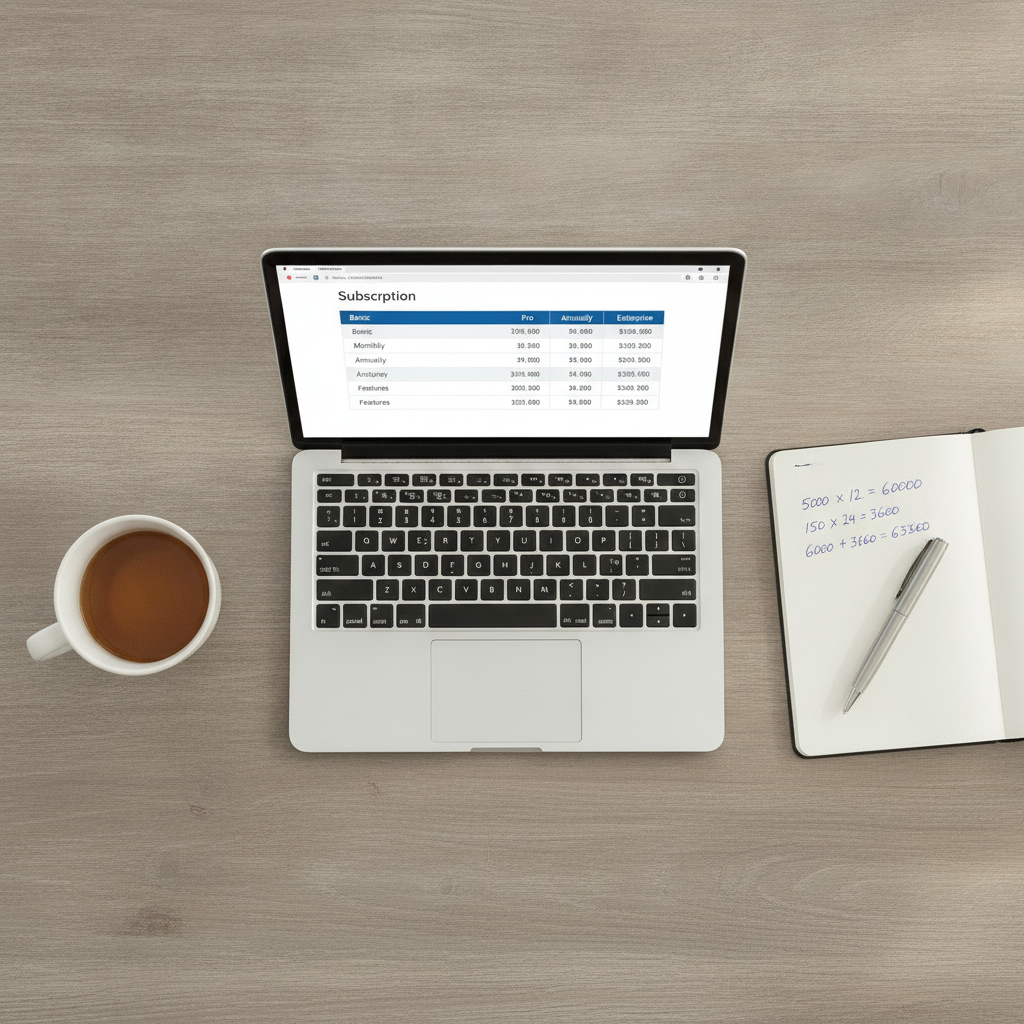
Consider a realistic scenario involving an AI-assisted research and drafting platform. The rolling monthly plan costs £30 per seat. The annual plan offers a twenty percent discount, bringing the price down to £24 per seat per month, billed as an upfront lump sum of £288 per seat for the full year. For a team of five knowledge workers, the upfront annual payment is £1,440, whereas the rolling monthly cost sits at £150 per month for all five seats combined.
To find the break-even threshold, divide the upfront annual cost of £1,440 by the monthly expenditure of £150. The result is exactly 9.6 months. This means your team must actively use all five seats for ten full months before the annual discount yields any financial benefit. If your team discovers after five months that only two colleagues use the software, continuing on the monthly plan would have cost £750 for the first five months and £60 per month for the remaining seven months, totalling £1,170. By committing annually upfront, you spent £1,440, needlessly losing £270 despite receiving a twenty percent discount.
Which AI tools justify an annual commitment?
An annual commitment makes financial sense only when a product possesses strong operational defensibility. Defensibility in AI software does not stem from clever prompt engineering or an attractive user interface. It stems from high switching costs, proprietary internal context, and deep workflow integration that would require weeks of engineering effort to replace.
Software categories that qualify for annual purchasing include developer code repositories with deeply embedded compliance rules, enterprise knowledge retrieval systems that hold indexed corporate documentation, and customer support infrastructure trained on years of resolved tickets. In these cases, moving to a competitor requires significant operational downtime, data migration, and staff retraining. The cost of technological lock-in is already accepted, making an upfront discount sensible.
Conversely, single-purpose generative tools such as generic writing assistants, standalone presentation makers, transcription widgets, and basic image generators should remain on monthly agreements. These utilities rarely retain proprietary company data, feature zero switching barriers, and face constant competitive pressure from foundation models that can absorb their functionality overnight.
How does team seat churn distort subscription economics?
Seat licensing creates hidden waste when applied to emerging technology. In an average department, AI literacy and interest vary widely between individuals. When managers purchase annual seats for an entire unit, they assume equal adoption across the roster. Within three months, usage metrics almost always reveal that a small fraction of the team drives eighty percent of all prompts and outputs.
On an annual contract, those unused seats become pure shelfware. Most software contracts do not permit downward seat adjustments mid-term; vendors only permit additions. If you hire someone, you can easily pay pro-rata for an additional licence, but if an employee departs or stops using the software, you must continue servicing that seat until the annual renewal date arrives.
A rolling monthly approach transforms software licences into a variable operational expense that tracks actual team requirements. If two team members transition to a different project where the software is irrelevant, you immediately remove their licences on the next billing date. The flexibility to adjust seat counts month-to-month routinely produces higher aggregate cost savings than any static twenty percent annual discount.
How quickly do underlying model upgrades alter product value?
The pace of frontier model deployment introduces a dynamic that legacy software purchasing policies are not designed to handle. When a foundation lab releases a more capable reasoning model, the competitive hierarchy across AI applications shifts within days. Features that previously required complex external software architectures can suddenly be executed with a single prompt inside general-purpose interfaces.
If you sign an annual agreement with a specialist vendor in March, by August that vendor might be relying on outdated model architecture that lags behind public alternatives. You can find yourself in the frustrating position of paying for an enterprise licence while your employees quietly achieve superior, faster results by using personal accounts on newer foundation models outside your enterprise stack.
Furthermore, model competition consistently exerts downward pressure on the cost of intelligence. Over any twelve-month window, the cost per million tokens for equivalent performance has historically dropped by substantial percentages. When token prices fall, software that bills on usage or API volume becomes cheaper, whereas fixed annual seat licences insulate the vendor from passing those market savings back to you.
How should you structure a quarterly review for ongoing monthly tools?
Retaining monthly flexibility is only beneficial if you actively manage the billing cycle rather than letting rolling subscriptions run indefinitely on corporate credit cards. Unmonitored monthly subscriptions quickly turn into permanent overhead that combines the higher monthly price point with the worst aspect of annual commitments: paying for tools nobody looks at.
Establish a formal sixty-day audit cycle for all generative software subscriptions. Require seat holders to submit a basic utilisation confirmation every two months, showing that the platform supported at least three completed deliverables during that timeframe. Most enterprise admin dashboards provide exportable telemetry showing last-login dates, session durations, and total queries executed.
When utilisation for a specific user drops below your minimum threshold, cancel the seat immediately. Returning to the platform later requires nothing more than entering payment details again, as account configurations and histories are typically retained by vendors for months following cancellation. By maintaining strict monthly pruning routines, you preserve strategic agility and enforce discipline on software spend.
What do people ask most about this?
Can you negotiate an annual discount rate on a monthly billing schedule?
Yes, software sales representatives frequently possess the authority to offer discounted rates on month-to-month contracts, particularly toward the conclusion of a financial quarter. If your team is purchasing more than ten seats, ask the vendor to match their annual per-seat pricing on a flexible monthly arrangement in exchange for a committed ninety-day evaluation term. Enterprise software sales teams prioritize customer acquisition metrics and will often accommodate hybrid terms if you make it clear that a rigid annual lock-in is a dealbreaker.
What happens to your proprietary data when you cancel a monthly AI subscription?
Most business-tier AI software vendors retain your workspaces, project templates, and prompt histories for thirty to ninety days after subscription cancellation to facilitate easy reactivation. However, you should always export your generated assets, custom documentation, and vector database contents before terminating billing. Review the vendor's data retention policy beforehand to confirm whether your proprietary data is deleted from their active servers upon account closure, ensuring compliance with your organisation's information security standards.
Is it ever sensible to pay annually for foundation platforms like OpenAI or Anthropic?
For standard team chat interfaces, paying annually remains inadvisable because personal and team workflows continue to migrate across providers as new benchmark leaders emerge. However, for direct API usage, annual spend commitments are entirely different. Cloud infrastructure providers and frontier labs offer discounted compute rates or dedicated capacity reservations through committed use discounts. If you run a custom application in production that requires guaranteed throughput, an annual API commitment makes sense once baseline volume is proven.
How do price reductions from model providers affect annual software contracts?
Annual enterprise contracts lock in pricing at the moment of execution. If an underlying model provider halves its API token costs three months into your twelve-month agreement, the vendor typically pockets the margin expansion rather than passing the savings through to existing annual subscribers. This structural lag is one of the most compelling reasons to remain on rolling monthly terms, as monthly contracts allow you to switch to cheaper, modernized tools that reflect real-time market pricing.
How was this article researched?
This article is written and maintained by Jim Vernon, Editor at AI Intelligence International. Figures and claims are drawn from the calculators and models published on this site, from vendor documentation current at the time of writing, and from first-hand testing of the tools described. Every article is reviewed against our editorial standards before publication and re-checked whenever the underlying tools or pricing change.