Tools & Buying
Should You Choose Per-Seat or Usage-Based Pricing for AI Software?
Choose usage-based pricing when adoption across your team is uneven, task volume fluctuates by season, or you are testing new workflows. Choose per-seat pricing when a core group uses the software daily for high-volume tasks and predictable operational budgeting is essential. Most companies waste money on per-seat plans by paying full monthly licences for light, occasional users who consume only pence worth of tokens.
The shift towards generative artificial intelligence has upended standard software procurement. For two decades, software-as-a-service relied almost entirely on fixed monthly per-seat subscription licences. Because running machine learning models incurs real compute expenses on every prompt, vendors now offer metered, credit-based, or token-based consumption tiers alongside traditional seats. Deciding between these two structures requires an honest assessment of your actual operational tempo rather than vendor sales projections.
By Jim Vernon, Editor, AI Intelligence International · Published 1 October 2026 · Reviewed against our editorial standards · About the author
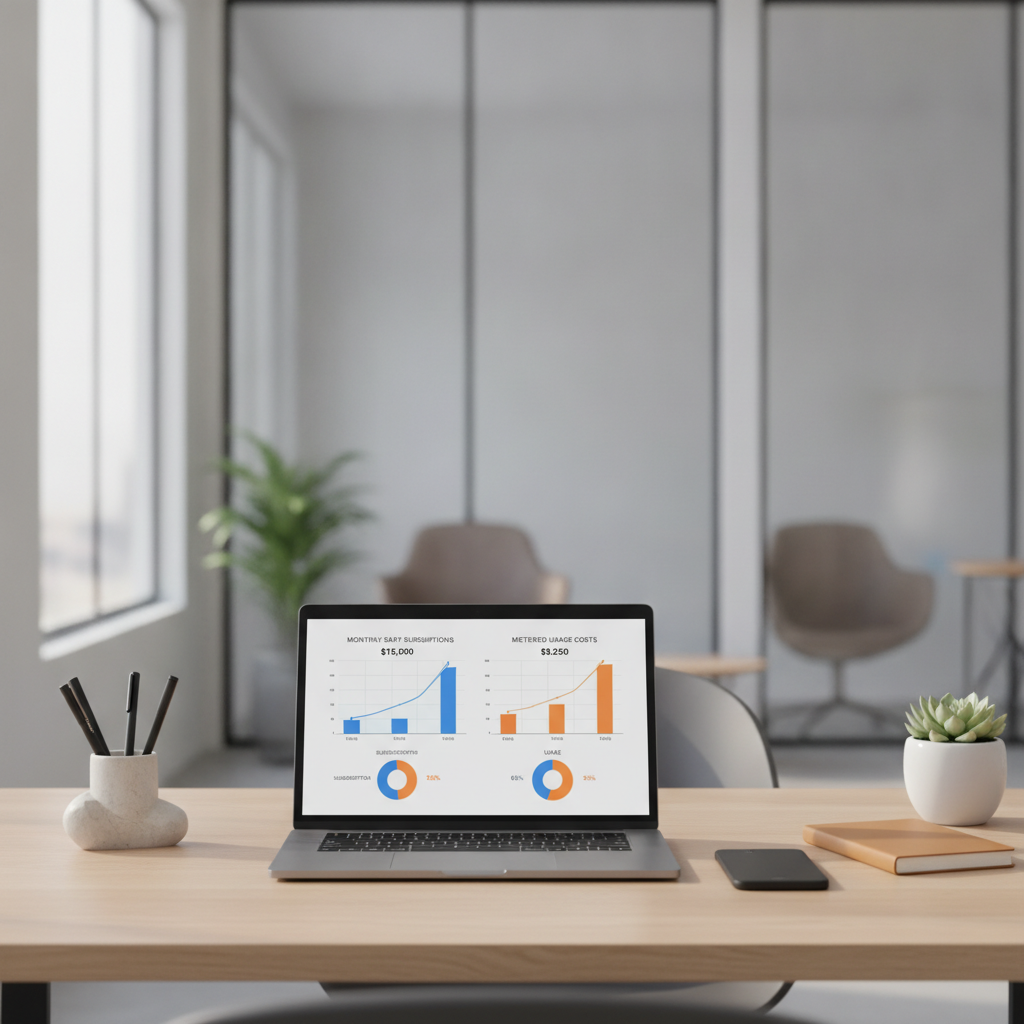
What are the key takeaways?
- Per-seat pricing penalises teams with uneven adoption because casual users cost the same as power users.
- Usage-based billing lowers upfront commitments but requires automated spend ceilings to prevent runaway costs from automated loops.
- The financial break-even point between seat and consumption models depends entirely on individual prompt density and daily query frequency.
- Hybrid purchasing where power users hold seats while occasional staff draw from metered pools yields the lowest blended cost.
What does this article cover?
| Question answered | Should You Choose Per-Seat or Usage-Based Pricing for AI Software? |
|---|---|
| Topic | Tools & Buying |
| Reading time | About 8 minutes (1,683 words) |
| Written by | Jim Vernon, Editor, AI Intelligence International |
| Published | 1 October 2026 |
| Last updated | 1 October 2026 |
What Is the Difference Between Per-Seat and Usage-Based AI Pricing?
Per-seat pricing charges your business a fixed monthly or annual recurring fee for each named employee who has access to the tool. Under this model, whether an employee generates three hundred complex documents each afternoon or opens the application once a fortnight to check a summary, the invoiced charge remains identical. The software vendor absorbs the variable inference cost across all customers, setting a price point that protects their average gross margin across both intense and negligible workloads.
Usage-based pricing charges you directly for the volume of computational work your team triggers. This metric may be measured in raw input and output tokens, discrete system credits, total processing minutes, or individual query completions. If your team takes time off or leaves a project dormant for three weeks, your invoice drops to zero or a minimal base platform maintenance charge. However, if a team member runs recursive prompts over massive datasets, your costs expand immediately in direct proportion to that usage.
When Does Per-Seat Pricing Cost You More Money?
Per-seat pricing becomes an expensive mistake when tool adoption is uneven across your department. In most organisations, software rollouts follow a severe power-law distribution. A small cadre of enthusiastic employees integrates the software into every hourly routine, while the broader majority tests the platform once or twice during the introductory week and rarely logs in again. When you purchase fifteen or fifty licences on an annual contract, you pay full commercial rates for widespread digital shelfware.
This model also penalises teams with cyclical workloads. Accountancy practices, seasonal retailers, and project-based consultancies do not operate at a steady, uniform capacity throughout the calendar year. Paying a static monthly fee per head during quiet periods drains operational cash reserves without providing corresponding value. If you cannot guarantee that every licensed user will extract tangible value several times each working week, flat per-seat subscriptions quickly generate substantial waste.
When Is Usage-Based AI Pricing a Financial Trap?
Usage-based pricing introduces volatility that can disrupt tight departmental budgets. Because fees scale with every query, unmanaged teams can accumulate massive invoices before finance teams notice the pattern. An inexperienced employee who pastes entire codebases into an unoptimised prompt window or sets an autonomous agent to scrape hundreds of web pages in a loop can exhaust hundreds of pounds of compute credits in a single afternoon.
Beyond the danger of rogue scripts, metered billing can create an unhealthy psychological barrier to everyday work. When staff know that every question or revision carries a visible financial penalty on the company credit card, they hesitate to experiment or use the tool for routine problem-solving. This hesitation defeats the entire purpose of investing in modern technology. If predictability of monthly overheads is your primary procurement goal, pure consumption pricing without hard technical budget caps is a genuine financial hazard.
How Do You Calculate the Break-Even Point Between Models?
To determine which structure saves money, you must calculate the monthly break-even threshold using your anticipated query volume. Consider a realistic working scenario with a departmental team of fifteen staff members evaluating an AI document analysis platform. The vendor offers two options: a flat per-seat subscription of £30 per user per month, or a usage-based tier charging a £50 monthly base platform fee plus £0.04 per processed document. Under the seat model, fifteen users cost exactly £450 every month, producing an annual software commitment of £5,400.
Now analyse actual operational habits under the usage model. Suppose three power users process forty documents each working day across twenty business days per month, producing 2,400 documents at a cost of £96.00. Five moderate users process eight documents daily, totalling 800 documents for £32.00. The remaining seven light users process just one document per day, generating 140 documents for £5.60. Total monthly volume across all fifteen people is 3,340 documents. At £0.04 each, the usage charge is £133.60. Adding the £50 base fee brings total spend to £183.60. The usage model saves £266.40 per month, cutting software overheads by 59.2 percent.
To identify the break-even volume, take the £450 seat cost, subtract the £50 base fee, and divide the remaining £400 by the £0.04 unit cost. The break-even point is exactly 10,000 document tasks per month across the team. That requires an average of roughly 667 tasks per employee per month, or more than thirty-three tasks per worker every single working day. Unless your entire workforce operates at power-user velocity, usage pricing delivers substantial savings.
How Should You Manage Usage Spikes and Guardrails?
If you select usage-based billing, implementing strict technical guardrails is non-negotiable. Modern software administration portals allow managers to configure workspace budgets, hard spend limits, and automated warning notifications. A hard cap ensures that API calls or metered executions instantly halt once your monthly ceiling is reached, eliminating the possibility of shock bills. Soft alerts can warn leadership when spending touches fifty and eighty percent of the allocated threshold.
In addition to workspace-level ceilings, establish granular user quotas. Assigning individual monthly usage allowances prevents a single enthusiastic team member from draining the pool intended for the entire division. You should also instruct staff on token hygiene, showing them how trimming bloated context windows, removing repetitive conversational history, and structuring concise prompts directly preserves company capital without reducing output quality.
What Is a Practical Hybrid AI Procurement Strategy?
The most cost-effective arrangement for mid-sized organisations is rarely an all-or-nothing choice. Instead, practical procurement teams negotiate hybrid agreements that assign per-seat licences exclusively to verified power users while placing the rest of the company on a shared metered pool. For example, your dedicated research analysts and content specialists receive unlimited per-seat accounts, allowing them to iterate freely without administrative friction.
Meanwhile, general administrative staff, project coordinators, and occasional contributors access the tool through a pooled corporate account billed on consumption. This setup captures the best characteristics of both pricing structures. It grants predictable cost certainty for high-density workflows while ensuring you never pay an inflated monthly retainer for employees who only require the technology once a week.
What Questions Should You Ask AI Vendors Before Signing?
Before entering any commercial contract, interrogate the vendor on their usage mechanics and account governance. Ask whether unused credits roll over to the subsequent billing cycle or expire at midnight on the final day of the month. Expiring credits represent an artificial cost inflator designed to transfer financial risk back onto your balance sheet. Always demand written clarification on whether platform feature updates alter baseline token consumption rates for routine tasks.
Furthermore, confirm what telemetry tools the vendor supplies inside the administrator dashboard. You need granular visibility into which departments, workflows, and individual accounts generate compute spikes. If a vendor cannot provide real-time consumption dashboards, role-based budget limits, and hard financial cut-offs, avoid their consumption model entirely. Sign only with providers whose commercial terms permit quarterly adjustments between seat allocations and usage pools as your operational needs evolve.
What do people ask most about this?
Can usage-based AI billing cause surprise invoices at the end of the month?
Yes, usage-based billing can easily cause unexpected invoices if your administrative console lacks hard expenditure limits. Unlike traditional software that simply locks access when licence thresholds are reached, unconstrained API-driven or credit-based platforms continue executing requests until the billing cycle terminates. To prevent financial surprises, always configure hard billing ceilings directly within the vendor portal rather than relying solely on email warning notifications. A hard limit automatically terminates processing once a specific monetary amount is reached, protecting your cash flow from recursive prompt loops or unauthorised team projects.
Why are software vendors shifting away from simple flat-rate per-seat licences?
Software companies are moving away from purely flat per-seat models because artificial intelligence introduces variable marginal costs that traditional software never had. In legacy cloud platforms, hosting an additional active user cost fractions of a penny in database read-write cycles. Generative language models, however, require expensive graphical processing units for every single prompt calculation. If an enterprise customer purchases an unlimited seat for £25 and runs continuous programmatic workloads through it, the vendor can lose money on that account. Tiered consumption models pass that direct compute exposure back to the customer.
How can you track individual employee token consumption accurately?
Tracking individual consumption requires deploying software tools that feature enterprise administrative controls and user-level analytics. Most professional platforms provide audit logs indicating exactly how many queries, input tokens, and completion tokens each named team member initiates during a given billing window. If you deploy open-source models or direct API connections internally, you can route requests through an internal API gateway or proxy layer. This architecture logs each employee key, measures the payload size, and attributes computational costs directly to specific departmental cost centres.
Which pricing model is better for small teams of under ten people?
For teams under ten people, usage-based or pay-as-you-go pricing is almost always the superior choice during the first six months of adoption. Small teams rarely maintain identical usage patterns across every role; a software developer might use the tool heavily while an operations manager touches it occasionally. Paying fixed monthly subscription fees for ten separate seats often results in paying for unused capacity. A metered arrangement lets the team explore the software, determine real operational workflows, and accumulate actual usage data before committing to fixed annual seat contracts.
How was this article researched?
This article is written and maintained by Jim Vernon, Editor at AI Intelligence International. Figures and claims are drawn from the calculators and models published on this site, from vendor documentation current at the time of writing, and from first-hand testing of the tools described. Every article is reviewed against our editorial standards before publication and re-checked whenever the underlying tools or pricing change.