Tools & Buying
Should You Buy an AI Aggregator or Separate Model Subscriptions?
You should choose an AI aggregator if you require occasional access to multiple leading models for comparative testing and want to cap your monthly outlay under £30. You should pay for individual flagship subscriptions if your daily workflow depends on native features like custom web browsing, specialised voice modes, interactive code execution environments, long persistent workspaces, or official data privacy commitments that aggregators frequently lack.
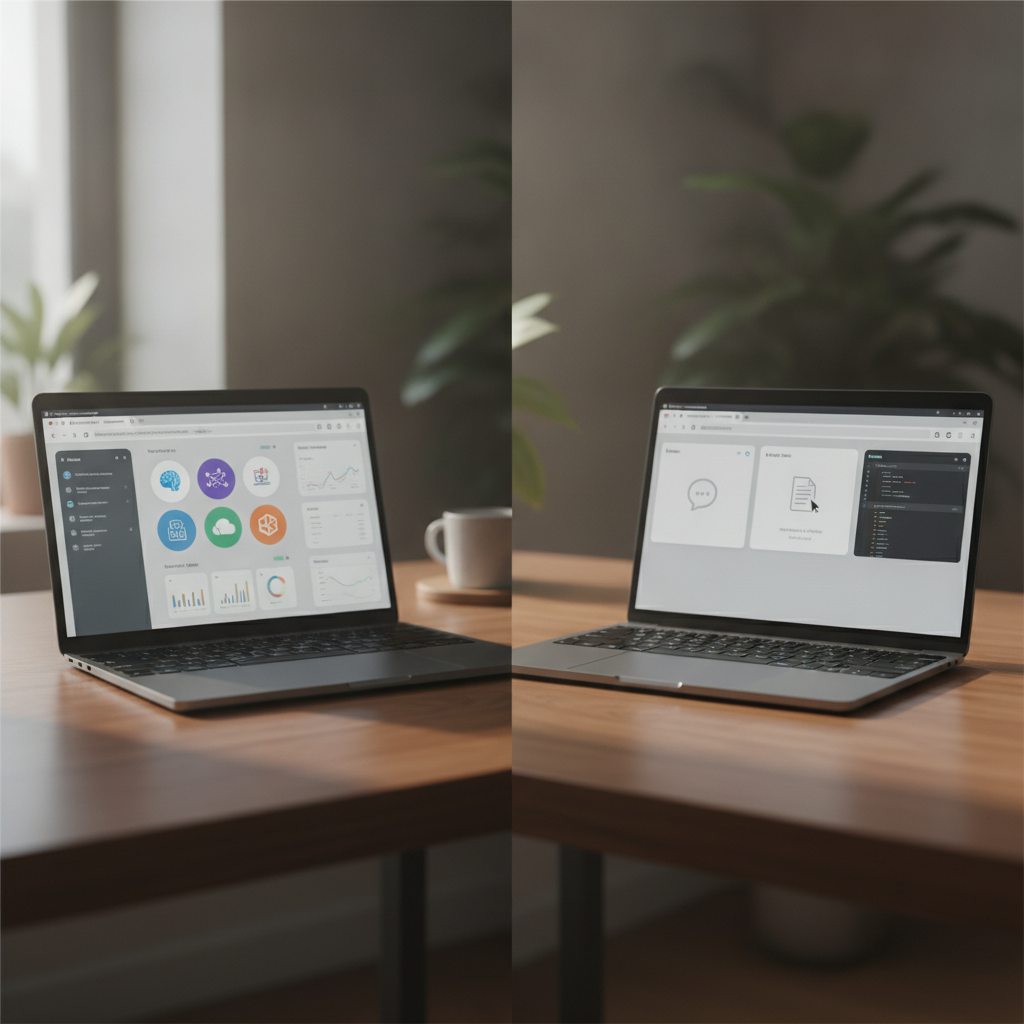
Knowledge workers and small teams frequently face subscription fatigue as frontier labs release competing models in rapid succession. Maintaining separate monthly accounts for OpenAI, Anthropic, and Google quickly totals £60 or more each month per person. Aggregator platforms promise access to every major model behind a single unified interface for a fraction of the total price, but the trade-off involves subtle architectural compromises, missing native features, and variable rate limits.
By Jim Vernon, Editor, AI Intelligence International · Published 19 September 2026 · Reviewed against our editorial standards · About the author
What are the key takeaways?
- Direct subscriptions provide full native capabilities like native canvas interfaces, persistent memory, and official zero-data-retention guarantees that aggregators cannot match.
- Aggregators reduce monthly software spend by up to 60 percent for generalist users who only need text generation across multiple frontier models.
- Aggregator platforms often route requests through standard API tiers, which can restrict context window sizes and strip out proprietary advanced voice or web search tools.
- For multi-model power users, combining a single flagship subscription with pay-as-you-go API keys in a third-party client is usually cheaper and more capable than an all-in-one consumer aggregator.
What does this article cover?
| Question answered | Should You Buy an AI Aggregator or Separate Model Subscriptions? |
|---|---|
| Topic | Tools & Buying |
| Reading time | About 6 minutes (1,352 words) |
| Written by | Jim Vernon, Editor, AI Intelligence International |
| Published | 19 September 2026 |
| Last updated | 19 September 2026 |
What is the core functional difference between an aggregator and a direct subscription?
When you purchase an individual direct subscription from a provider like Anthropic or OpenAI, you buy access to an entire proprietary product ecosystem. This includes tailored user interfaces, specialized canvas editors, native sandboxed Python environments for executing data analysis, persistent custom instructions, and live voice interactions. The model runs within the vendor's optimised infrastructure with prompt caching designed specifically for their proprietary platform.
An AI aggregator operates differently. Aggregators are third-party software layers that purchase enterprise or developer API access from foundation model providers and resell access through a single dashboard. When you submit a prompt inside an aggregator, the platform forwards your input across an API to the relevant lab and streams the response back. You gain convenient access to Claude, GPT-4o, and Gemini in one browser tab, but you interact with basic API completions rather than the lab's bespoke product suite.
How do the monthly costs compare across different usage patterns?
A realistic cost comparison depends on how many models you genuinely use each working week. If you subscribe individually to ChatGPT Plus at £16 per month, Claude Pro at £16 per month, and Gemini Advanced at £19 per month, your combined baseline commitment is £51 each month, or £612 annually before value added tax. If you only touch Claude twice a week and Gemini once a month, that money is largely wasted on idle overhead.
A dedicated consumer aggregator typically charges between £16 and £25 per month for a unified subscription. In this setup, your annual outlay falls to approximately £192 to £300, representing an immediate annual saving of at least £312. However, these platforms ration access using proprietary credit pools. Heavy daily use can exhaust your fast credits before the month concludes, throttling your generation speed or downgrading queries to smaller open-weight alternatives.
What is a concrete breakdown of aggregator credit limits versus direct access?
Consider a knowledge worker who processes 40 analytical queries every working day across 21 working days per month, yielding 840 total monthly prompts. On direct subscriptions, a user paying £32 per month for both ChatGPT Plus and Claude Pro receives generous native message allowances that reset every three to five hours. Under normal professional working patterns, 40 detailed queries daily fall comfortably within these rolling caps without incurring additional charges.
On a typical £20 monthly aggregator plan providing 1,000 standard credits, complex frontier queries often consume five credits each rather than one. Processing those 840 queries through top-tier reasoning models requires 4,200 credits. At that consumption rate, the included monthly allowance expires in five working days. Purchasing 3,200 supplementary credits at £8 per 1,000 units adds £25.60 to the monthly invoice, bringing the real cost to £45.60 per month for an inferior, API-constrained interface.
Which native features do you lose when using an aggregator?
The primary compromise of third-party platforms is the loss of platform-specific features engineered into native web applications. Anthropic's interactive Artifacts interface allows you to view, modify, and render React components, SVG graphics, and markdown documents directly beside the chat stream. Standard aggregators cannot fully replicate this bespoke rendering layer, delivering raw code snippets instead.
Similarly, OpenAI's Advanced Voice Mode relies on low-latency end-to-end multimodal audio processing that is unavailable through standard chat completion APIs. If you rely on running Python scripts inside the browser to parse spreadsheets, generate charts, or inspect documents, direct subscriptions handle this natively inside sandboxed virtual machines. Most aggregators lack integrated code execution sandboxes, forcing you to copy code manually to a local terminal or external environment.
How do privacy policies and data retention rules differ between options?
Direct consumer subscriptions generally allow users to opt out of model training within account settings, and business or team tiers explicitly prohibit vendors from training models on user inputs. Large foundation model labs also publish strict enterprise security compliance reports, including SOC 2 Type II certifications and clear standard contractual clauses governing data transfers across international borders.
Aggregators introduce an intermediate third party into your data chain. When you transmit confidential client records, financial summaries, or internal proprietary code through an aggregator, that data is processed by the aggregator's servers before being forwarded to the underlying model provider's API. Even if the foundation lab does not train on API requests, you remain subject to the aggregator's internal storage policies, employee access controls, and logging infrastructure. For regulated industries or corporate consulting, this architectural routing often breaches internal security standards.
When does using a bring-your-own-key client beat both models?
For technical professionals, freelancers, and small engineering teams, a hybrid approach often outperforms both consumer aggregators and multiple direct accounts. You can install an open-source or one-time-purchase desktop client like TypingMind, LibreChat, or Chatbox, and plug in your own developer API keys from OpenAI, Anthropic, and Google.
This architecture charges you strictly for exact input and output tokens consumed, eliminating flat monthly retainers entirely. If you write 100,000 words of prompts and receive 200,000 words of frontier model responses across a quiet month, your raw API invoice might total under £8 across all providers combined. You retain full control over your prompt caching parameters and API data retention agreements while switching seamlessly between models in a single clean interface.
What do people ask most about this?
Can an AI aggregator replace both ChatGPT Plus and Claude Pro entirely?
An aggregator can replace both accounts if your daily work involves standard text generation, summarisation, basic translation, and short-form drafting where you simply want to compare outputs. However, if your day-to-day workflow relies on Claude's Artifacts workspace, OpenAI's Advanced Voice Mode, automated web-browsing integrations, or custom GPT configurations with pre-loaded knowledge files, an aggregator will feel restrictive because it accesses these models solely through external developer APIs that omit proprietary user features.
Do aggregators provide the exact same answers as the direct web tools?
In general, the underlying reasoning is identical because the aggregator queries the same frontier model weights via official APIs. However, system prompts and temperature settings differ. Direct subscription interfaces often include extensive invisible instructions, internal search tools, and retrieval mechanisms tuned to make responses comprehensive. An aggregator might query the base model with minimal scaffolding, meaning answers can appear shorter, less conversational, or less up-to-date unless the aggregator provides its own live search infrastructure.
Is it cheaper to use pay-as-you-go API keys instead of an aggregator?
For light to moderate users, paying foundation model providers directly for API consumption is substantially cheaper than paying £16 to £25 per month for an aggregator. If you send fewer than 30 complex prompts a day, your raw monthly API bill across OpenAI, Anthropic, and Google will rarely exceed £10. Aggregators charge a fixed monthly margin on top of API costs to run their servers and provide customer support, meaning low-volume users effectively overpay.
Are aggregator subscriptions safe for sensitive corporate data?
Using consumer aggregators for sensitive corporate data carries heightened risk because your information flows through two separate companies: the aggregator platform hosting the interface and the foundation lab running the weights. While frontier labs generally state that API inputs are not used to train public models, the intermediary aggregator may store conversation logs and telemetry on its own cloud servers. Corporate users handling regulated or confidential data should require signed enterprise agreements before routing data through third-party intermediaries.
How was this article researched?
This article is written and maintained by Jim Vernon, Editor at AI Intelligence International. Figures and claims are drawn from the calculators and models published on this site, from vendor documentation current at the time of writing, and from first-hand testing of the tools described. Every article is reviewed against our editorial standards before publication and re-checked whenever the underlying tools or pricing change.