Developer & Tech
How Do You Structure Evals Before Shipping an AI Feature?
To structure evaluations before shipping an AI feature, establish a deterministic ground-truth dataset of at least 100 diverse inputs, define rigid task-specific rubrics, and run automated assertion checks alongside model-graded evaluations. This quantitative gate ensures changes to prompts, upstream models, or retrieval pipelines do not quietly degrade your product before reaching production users.
Many engineering teams treat testing generative AI features as an informal exercise, relying on a handful of ad-hoc playground queries or developer intuition. That approach fails the moment you update a system prompt or switch foundation models. Without systematic evaluations, you cannot measure regressions, quantify hallucination rates, or know whether a new iteration genuinely improves real-world task performance.
By Jim Vernon, Editor, AI Intelligence International · Published 10 September 2026 · Reviewed against our editorial standards · About the author
What are the key takeaways?
- Informal prompt checks cannot catch regressions; shipping software requires repeatable test suites with deterministic benchmarks.
- A production-ready eval suite combines basic programmatic assertions, deterministic reference matches, and calibrated LLM judges.
- Curating an initial dataset of 100 representative edge cases delivers far more diagnostic value than running thousands of generic synthetic tests.
- Tracking metric changes across versions prevents subtle model degradation from reaching your active user base.
What does this article cover?
| Question answered | How Do You Structure Evals Before Shipping an AI Feature? |
|---|---|
| Topic | Developer & Tech |
| Reading time | About 7 minutes (1,468 words) |
| Written by | Jim Vernon, Editor, AI Intelligence International |
| Published | 10 September 2026 |
| Last updated | 10 September 2026 |
Why do informal manual checks fail in production?
Testing an AI feature by pasting five favourite examples into a web console creates a false sense of reliability. Language models are non-deterministic and highly sensitive to small phrasing adjustments. When an engineer modifies an instruction to address a single edge case, that tweak frequently causes unintended degradations across three unrelated customer scenarios.
Manual spot-checking also suffers from confirmation bias. Developers look for the specific output improvements they set out to achieve, routinely missing subtle formatting breakages, newly introduced hallucinations, or tone shifts. Without persistent, reproducible test records, your team cannot establish whether output quality is trending upwards or steadily decaying over successive product releases.
As your application scales to thousands of daily queries, statistical drift becomes visible to your users long before it shows up in casual spot checks. Systematic evaluation replaces subjective sentiment with repeatable scores, creating clear acceptance criteria that your pull requests must satisfy before deployment.
What types of evaluation metrics should you track?
A practical evaluation pipeline separates metrics into three distinct layers: deterministic assertions, semantic similarity tests, and model-graded qualitative rubrics. Starting with programmatic assertions is the fastest way to weed out broken outputs. These checks verify strict structural constraints, such as valid JSON syntax, exact schema conformance, maximum token counts, and the presence or absence of forbidden substrings.
The second layer checks factual correctness and retrieval precision against defined ground truth. For instance, in retrieval-augmented generation (RAG), you measure context recall to see whether the underlying retrieval system fetched the relevant passage, along with context precision to verify that irrelevant text was excluded. You can then evaluate whether the generated answer relies strictly on that fetched context.
The third layer uses an LLM judge to evaluate nuanced qualities such as tone, completeness, and adherence to complex domain guidelines. To make LLM judges reliable, you must supply a granular binary scoring rubric rather than asking for an arbitrary rating out of ten. Asking whether a specific instruction was executed yields far more consistent results than asking for a subjective quality rating.
How do you build a useful evaluation dataset?
An evaluation dataset does not need thousands of rows to start delivering immediate engineering value. A rigorously curated benchmark of 50 to 100 production-like cases is sufficient to catch the vast majority of prompt regressions. Start by selecting 30 typical user queries that represent standard usage patterns and core platform utility.
Next, populate the remaining rows with hard failure modes, adversarial attempts, and complex edge cases. Include queries with incomplete information, requests that violate system safety boundaries, inputs containing unusual characters, and questions where the correct response is to decline politely. These adversarial inputs act as guardrails against regressions when refining prompts.
Whenever a customer reports an unexpected output or a bug ticket is filed, sanitise that input and add it directly into your golden dataset alongside the desired behaviour. Over several months, this workflow naturally transforms operational mistakes into an indispensable, domain-specific regression suite that protects your application over time.
How do you calculate the true financial cost of running evals?
Running comprehensive evaluation pipelines introduces direct API spend, but this expenditure is negligible when compared to the cost of shipping broken software. Consider a production dataset of 150 test queries. Suppose you run an automated suite on every pull request that uses an advanced model to generate candidate answers and a secondary frontier model to grade them.
Assume each candidate test run processes 1,000 input tokens and generates 300 output tokens. At standard API rates of £2.00 per million input tokens and £8.00 per million output tokens, generating answers for 150 items costs £0.30 for inputs and £0.36 for outputs, totalling £0.66. If your LLM judge evaluates each response alongside reference rubrics using 1,500 input tokens and 150 output tokens at £4.00 and £16.00 per million tokens respectively, the grading pass costs £0.90 for inputs and £0.36 for outputs. Running the full evaluation suite costs exactly £1.92 per pipeline run.
If a squad merges 40 pull requests per month, running the full suite on every pull request amounts to £76.80 per month. That modest investment prevents broken schema structures, severe hallucinated claims, and customer churn. It gives leadership total confidence that releases will maintain uniform standards across model provider updates.
How should you implement an LLM-as-a-judge workflow?
Using one model to grade another requires strict guardrails to prevent position bias, verbosity bias, and random scoring variance. First, never ask an LLM judge to output a loose grade on a scale from one to ten. Models tend to cluster ratings around seven, obscuring subtle differences in generation quality.
Instead, decompose evaluations into discrete boolean questions. Ask the judge: 'Does the generated output claim any fact not directly supported by the context? Answer Yes or No.' Follow that with: 'Does the response address all three constraints stated in the user prompt? Answer Yes or No.' Binary choices dramatically increase inter-evaluator reliability and correlate far more closely with human assessments.
Always require the judging model to output its chain of reasoning before returning its final pass or fail verdict. Forcing the model to explain why an output fails before emitting the score forces attention over specific criteria, noticeably cutting down on erroneous judgements.
How do you integrate evals into existing CI/CD pipelines?
Evals should behave just like unit tests in your team's pull request workflow, but with flexible threshold tolerances. Unlike traditional deterministic software where tests strictly pass or fail, AI features operate with an acceptable band of variance. Set your continuous integration pipeline to fail only when programmatic assertions break or when aggregate benchmark scores drop below your target threshold.
To keep developer workflows fast, split evaluations into two distinct tiers. Run a lightweight smoke test of 20 rapid assertions and structural checks on every standard Git commit, finishing in under thirty seconds. Reserve the full 150-case benchmark, complete with semantic grading and judge passes, for pull requests targeting staging or main branches.
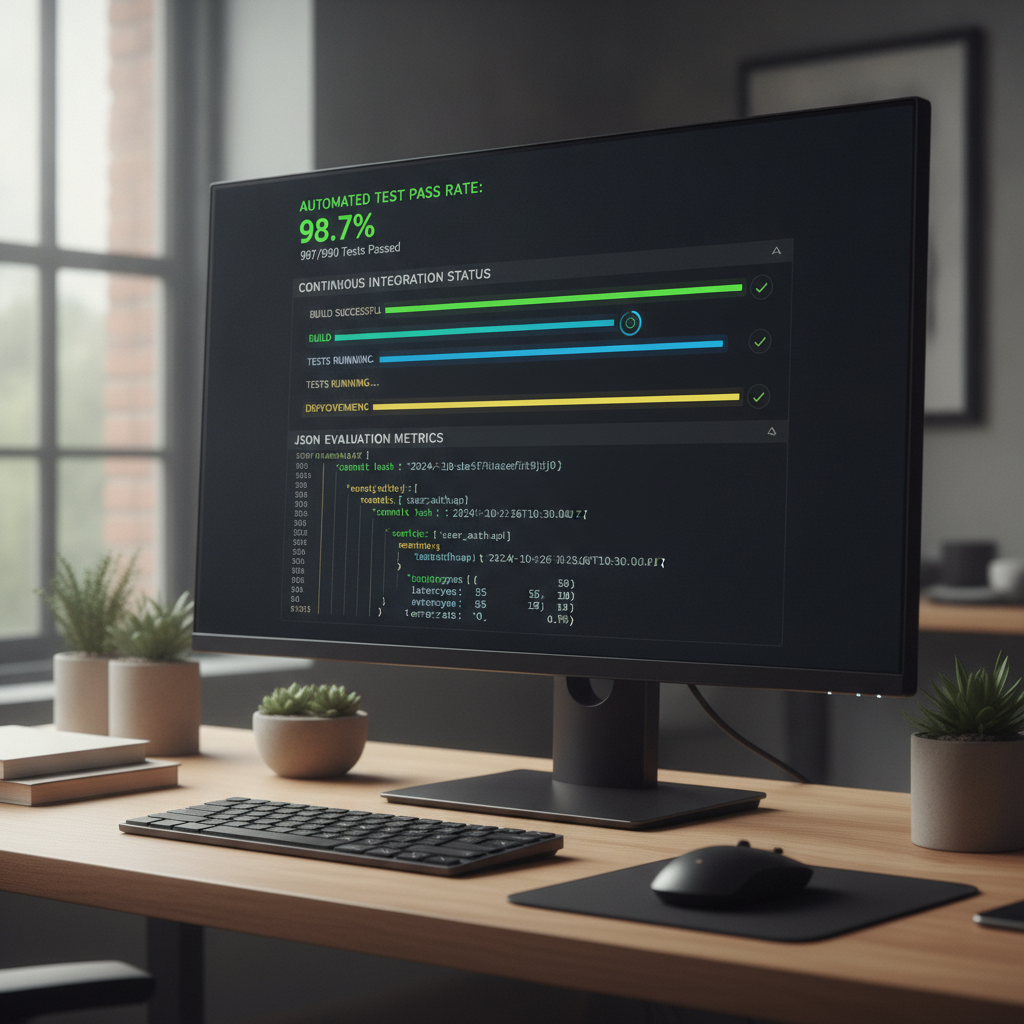
Store the raw results of every run in structured JSON or your tracking dashboard. Plotting passing percentages over time lets you see whether prompt iterations are expanding capabilities or quietly undermining edge-case safety. This visibility turns subjective architectural arguments into objective, data-backed engineering decisions.
What do people ask most about this?
How many test samples do I need to start a reliable eval pipeline?
You can begin building an effective evaluation suite with just 50 to 100 well-chosen test cases. Focus on quality and variety rather than sheer volume. Include thirty standard happy-path inputs, thirty complex domain questions, and twenty to thirty deliberate edge cases, adversarial prompts, or unanswerable queries. A tightly curated suite of 100 samples delivers clearer diagnostic signals than thousands of synthetically generated questions that fail to mirror authentic customer behaviour.
Should I use open-source benchmarks or create my own test set?
Public benchmarks like MMLU or HumanEval are designed to evaluate broad foundation models, not your specific application. They provide zero visibility into whether your prompt extracts invoice fields properly or matches your organisation's brand guidelines. While foundation model providers rely on standard benchmarks, application engineers should always build bespoke, proprietary test sets tailored directly to their product logic, user personas, and core business failure modes.
Can I use the same model to generate and judge outputs?
You should avoid using the exact same model to both generate and evaluate an output, as models exhibit significant self-preference bias. They routinely rate their own generations more favourably than outputs from competing architectures. If your application relies on a fast, cost-effective model for generation, use a more capable frontier model as the judge. When budget constraints mandate using the same family, use explicit few-shot reference examples to anchor grading.
What is the difference between offline evals and online monitoring?
Offline evaluations act as pre-merge regression tests run against static, curated benchmark sets before code or prompt changes reach production. Online monitoring inspects live user traffic in real time, tracking metrics such as latency, token consumption, user thumbs-up rates, and post-generation guardrail violations. You need both: offline evals prevent known bugs from shipping, while online monitoring catches novel edge cases to add back into your offline dataset.
How was this article researched?
This article is written and maintained by Jim Vernon, Editor at AI Intelligence International. Figures and claims are drawn from the calculators and models published on this site, from vendor documentation current at the time of writing, and from first-hand testing of the tools described. Every article is reviewed against our editorial standards before publication and re-checked whenever the underlying tools or pricing change.