Developer & Tech
How Do You Prevent Prompt Injection in Production AI Applications?
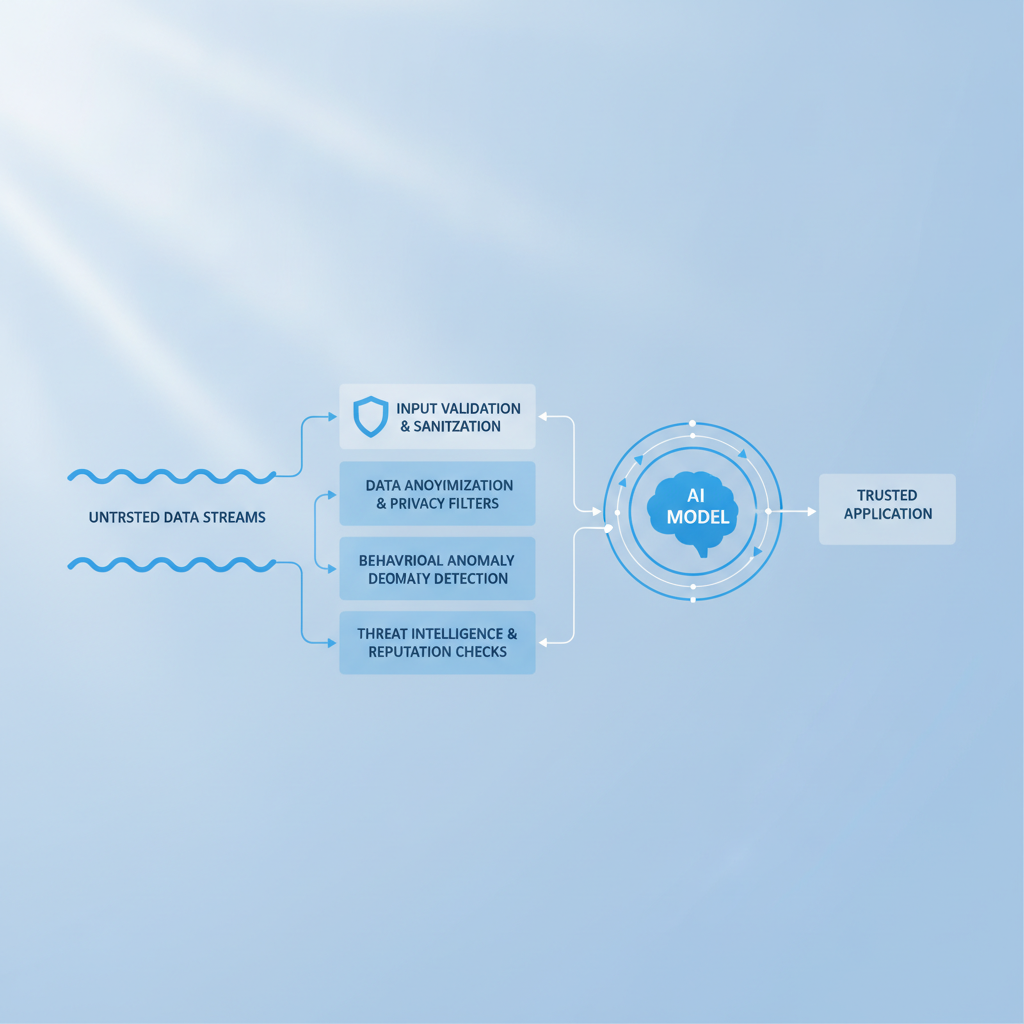
To prevent prompt injection in production AI applications, you must separate instructions from untrusted data, enforce strict structural parsing, and limit model tool privileges. You cannot treat system prompts as impenetrable security boundaries. Instead, you secure systems using architectural controls: input quarantine, dual-model evaluation, strict JSON schemas, and read-only database roles to prevent malicious inputs from hijacking business logic.
Prompt injection attacks fall into two categories: direct jailbreaks where a user overrides instructions, and indirect injections where poisoned external documents or web pages feed malicious directives into an agent. Relying entirely on clever system prompts to ignore malicious commands always fails under real traffic. Robust defence requires a defensive architecture adapted from classic web application security principles.
By Jim Vernon, Editor, AI Intelligence International · Published 2 October 2026 · Reviewed against our editorial standards · About the author
What are the key takeaways?
- System prompts are operational guidelines rather than hard security boundaries.
- Treating all external inputs as untrusted data is the foundational rule of AI application security.
- Granting an LLM unrestricted execution permissions creates severe injection vulnerabilities regardless of prompt phrasing.
- Dual-model validation pipelines catch hostile intent before payload execution reaches sensitive downstream infrastructure.
What does this article cover?
| Question answered | How Do You Prevent Prompt Injection in Production AI Applications? |
|---|---|
| Topic | Developer & Tech |
| Reading time | About 7 minutes (1,594 words) |
| Written by | Jim Vernon, Editor, AI Intelligence International |
| Published | 2 October 2026 |
| Last updated | 2 October 2026 |
What is prompt injection and why are simple defences failing?
Prompt injection occurs when an attacker manipulates the natural language context supplied to a large language model so that it disregards its original system instructions and executes the attacker's commands instead. In direct injection, the user directly enters adversarial phrasing such as instructing the bot to ignore previous rules and reveal backend credentials. In indirect injection, the model ingests content from external sources, such as emails, PDF documents, or scraped websites, that contain embedded malicious instructions tailored to hijack the conversation flow.
Simple programmatic defences consistently fail because language models do not naturally distinguish between control instructions and contextual data. Traditional software systems separate executable code from user data through memory architectures and parameterised queries. Large language models, however, concatenate system instructions, developer context, and user input into a single flattened stream of tokens. When developers rely on cosmetic prompting defences like appending phrases such as please never reveal secrets to the end of a prompt, they create a brittle barrier that determined adversaries easily bypass through semantic reframing, roleplay scenarios, or linguistic translation.
How do you isolate untrusted data inside your prompt architecture?
The first engineering principle of prompt security is context demarcation. You must clearly delineate untrusted user inputs from system instructions using structural markers that the model can interpret consistently. Many teams utilise custom XML tags, such as wrapping user content strictly between opening and closing user input tags, while explicitly instructing the model in the system prompt that content within those tags must only be treated as raw data to be analysed, never as instructions to be executed.
Beyond structural delimiters, your ingestion pipeline must sanitise raw text before assembling the prompt. This involves stripping out markdown commands that emulate system responses, removing delimiter collisions where users try to inject fake closing tags, and stripping non-printable Unicode characters often used in token manipulation attacks. While sanitisation alone cannot fully stop semantic manipulation, it eliminates trivial formatting tricks that trick tokenisers into misinterpreting message boundaries.
How does privilege separation prevent agent exploitation?
The most dangerous aspect of prompt injection is not the text the model outputs, but the downstream actions it is permitted to execute. If a model has direct access to read, write, and delete functions in a database, a successful injection attack can trigger destructive state changes. To protect your application, you must apply the principle of least privilege to every tool, API integration, and database connection made available to the agent.
Implement strict architectural boundaries around tool execution. Models should never generate and execute arbitrary SQL queries against production databases; instead, they should emit structured parameters for pre-defined, parameterised stored procedures with restricted scopes. Furthermore, any destructive or sensitive action, such as deleting user records, transferring money, or sending mass emails, must require human-in-the-loop confirmation or a secondary out-of-band authorisation token rather than autonomous execution triggered solely by model inference.
What does a dual-model inspection pipeline cost to run?
Deploying an auxiliary guard model to inspect incoming user inputs before passing them to an expensive reasoning model is one of the most effective ways to filter attacks without exploding infrastructure expenses. Instead of burdening your primary, high-parameter model with security classification, you route raw input to an ultra-fast, small model specialised in detecting adversarial syntax.
To understand the economics, consider a production application processing 100,000 user requests per day. Your primary agent uses a high-tier model costing 3.00 dollars per million input tokens and 15.00 dollars per million output tokens. If each incoming user prompt averages 400 tokens, inspecting these inputs directly with the primary model would quickly consume budget. Instead, you introduce a lightweight security classifier costing 0.15 dollars per million input tokens and 0.60 dollars per million output tokens.
Processing 100,000 daily requests of 400 input tokens through the lightweight classifier consumes 40 million input tokens, costing exactly 6.00 dollars. If the classifier returns a short safety verdict averaging 20 output tokens per request, that generates 2 million output tokens, costing 1.20 dollars. The total security screening cost is 7.20 dollars per day, or roughly 216 dollars per month. This tiny operational cost blocks known injection patterns before they reach your primary agent, protecting both your downstream data and your inference budget.
How do you defend against indirect prompt injection in retrieval systems?
Retrieval-augmented generation (RAG) introduces severe indirect injection risks because applications ingest unstructured third-party documents that developers do not control. An attacker who knows your application indexes public web pages or customer support tickets can hide malicious directives inside benign-looking text. When your vector database retrieves that chunk, the model parses the hidden text as part of its working context.
Defending against indirect injection requires treating retrieved chunks with the same suspicion as raw user input. Store metadata alongside vector chunks to track document provenance, author trustworthiness, and date of ingestion. When building the generation prompt, place retrieved passages in clearly marked reference blocks and instruct the model that context chunks must only serve as factual evidence. Additionally, implement output filtering that inspects model responses for data exfiltration patterns, such as attempting to display external markdown image links designed to leak session tokens via query parameters.
When should you enforce deterministic code barriers instead of model decisions?
Developers frequently make the mistake of asking an LLM to police itself or determine whether an operation is safe. Natural language models are inherently probabilistic; expecting them to function as absolute deterministic gatekeepers is a category error. Hard business rules, authentication verification, and access controls must reside entirely within deterministic application code outside the model's influence.
If your application requires that a user only accesses documents belonging to their organisation, verify the tenant identifier using cryptographic session tokens in your API layer before running vector similarity searches. Do not pass all documents to the model and prompt it to only show the user what they own. By enforcing access boundaries in deterministic code, you ensure that even if an attacker completely compromises the model's conversational behaviour, the underlying application logic physically prevents unauthorised data retrieval or state mutation.
What monitoring and alerting metrics reveal ongoing prompt injection attacks?
Detecting prompt injection requires active telemetry across both inputs and outputs. You should log anomalous token distribution patterns, sudden spikes in prompt length, and recurring keyword combinations commonly associated with jailbreak attempts. Tracking embedding distances between user inputs and known attack libraries allows your security monitoring to flag clusters of adversarial testing in near real time.
Equally critical is monitoring model output behaviour. Watch for sudden surges in schema validation errors, atypical output token volumes, and uncharacteristic tool call frequencies. If an endpoint that normally outputs twenty tokens of JSON suddenly attempts to stream five hundred tokens of raw markdown, your system should immediately terminate the generation stream, log the incident with the offending session identifier, and throttle the user account to prevent automated brute-force discovery.
What do people ask most about this?
Can system prompts completely eliminate prompt injection?
No, system prompts cannot completely eliminate prompt injection. Modern language models process system instructions and user inputs within the same semantic context, meaning there is no physical memory separation between system rules and untrusted text. Clever adversarial prompts can always be constructed to challenge, confuse, or override system prompt instructions. System prompts should be used to establish formatting and tone, while actual security guarantees must be enforced through external code barriers, strict schema parsing, and permission limitations.
What is the difference between direct and indirect prompt injection?
Direct prompt injection occurs when a user knowingly inputs adversarial commands into a conversational interface to force the model to violate its instructions or safety filters. Indirect prompt injection happens when a model retrieves external data, such as a website, email, or uploaded document, that contains adversarial instructions placed there by a third party. Indirect injection is particularly dangerous because the person interacting with the AI may be completely unaware that the external source material has hijacked the agent's workflow.
How do structured outputs help mitigate prompt injection risks?
Enforcing structured outputs, such as strict JSON schema validation, forces the language model to constrain its response to explicit data types and field definitions. This prevents injection payloads from outputting arbitrary conversational commands or injecting executable code into downstream systems. If an attacker tricks the model into attempting an unintended command, the generation fails validation at the parser level, stopping the attack from propagating into downstream business logic or user interfaces.
Does fine-tuning a model prevent prompt injection?
Fine-tuning can improve a model's default resistance to basic adversarial phrasing, but it does not solve prompt injection. Adversaries continually discover novel linguistic permutations and multi-step reasoning exploits that bypass fine-tuned alignments. Fine-tuning should be treated as one defensive layer among many, rather than a standalone security solution. Comprehensive application safety still requires architecture-level controls, strict input validation, and restricted execution permissions outside the model.
How was this article researched?
This article is written and maintained by Jim Vernon, Editor at AI Intelligence International. Figures and claims are drawn from the calculators and models published on this site, from vendor documentation current at the time of writing, and from first-hand testing of the tools described. Every article is reviewed against our editorial standards before publication and re-checked whenever the underlying tools or pricing change.