Side Hustle & Income
How Do You Package AI SOP Creation as a Paid B2B Service?
To package AI standard operating procedure creation as a paid B2B service, you record subject matter experts talking through their daily workflows, convert the raw audio into structured transcripts, use disciplined prompt chains to extract repeatable step-by-step procedures, and deliver verified operational manuals. You price the service as a fixed-scope productised sprint rather than hourly consulting, targeting firms with ten to fifty staff where founder knowledge bottlenecks growth.
Most growing small businesses suffer from undocumented tribal knowledge. Founders and senior operators spend dozens of hours every month onboarding staff, answering repetitive operational questions, and fixing errors caused by inconsistent execution. They know they need standard operating procedures, but writing documentation is tedious, slow, and perpetually delayed by immediate operational fires. AI drastically reduces the time required to turn messy spoken walkthroughs into polished operational documents, turning what used to be a painful multi-month consulting engagement into a profitable five-day deliverable.
By Jim Vernon, Editor, AI Intelligence International · Published 1 October 2026 · Reviewed against our editorial standards · About the author
What are the key takeaways?
- Clients do not pay for AI prompts; they pay for removing the friction of extracting operational knowledge from their busiest staff.
- Raw screen recordings and voice walkthroughs are far superior to written questionnaires as source material for standard operating procedures.
- A productised five-day documentation sprint at a fixed price converts significantly better than open-ended operational consulting.
- Human verification of edge cases, software permissions, and decision trees is the exact quality barrier that justifies professional fees.
- The most profitable targets are service firms with 10 to 50 employees who are actively hiring and feeling operational growing pains.
What does this article cover?
| Question answered | How Do You Package AI SOP Creation as a Paid B2B Service? |
|---|---|
| Topic | Side Hustle & Income |
| Reading time | About 8 minutes (1,679 words) |
| Written by | Jim Vernon, Editor, AI Intelligence International |
| Published | 1 October 2026 |
| Last updated | 1 October 2026 |
Why do growing companies pay for SOP documentation?
Small and medium businesses rarely fail from a lack of sales; they stall because their internal operations cannot scale past the founders and key operators. When an experienced employee leaves or takes annual leave, tasks stall or fall apart because the steps exist only inside that person's head. Onboarding a replacement often takes three to six months of shadowing, which drains the productivity of the remaining senior staff.
Business owners understand this problem intimately, yet internal documentation projects almost always fail. Writing clear, comprehensive standard operating procedures requires hours of uninterrupted focus, clear technical writing, and consistent formatting across departments. Busy managers do not have that time, and junior staff lack the bird's-eye perspective needed to document systems accurately. By offering an external service that captures their processes without requiring them to write a single paragraph, you solve an immediate, painful commercial problem.
What raw material do you collect from the client?
The primary reason traditional documentation projects collapse is that they ask busy operators to fill out long text templates. You must make the data collection phase virtually effortless for the client. The most effective source format is unscripted screen recordings and conversational audio. Ask team members to record themselves performing their standard tasks using tools like Loom, explaining out loud what they are clicking, why they make specific choices, and what common errors they watch for.
In addition to video walkthroughs, schedule short, 30-minute operational interviews for workflows that do not involve screen capture. Have the operator walk you through a process while you record the call. You then run the audio through an automated transcription tool to generate clean, timestamped text. These transcripts contain every necessary operational detail, technical term, and edge case, even if the spoken delivery is rambling, disjointed, or full of verbal filler.
How do you structure the AI prompt workflow for SOPs?
Raw transcripts cannot simply be converted into procedures with a single generic prompt like 'turn this into an SOP'. A reliable workflow breaks the task into three distinct stages: extraction, structuring, and validation. In the extraction stage, you feed the transcript into a large language model with instructions to extract four specific elements: the primary objective, required pre-requisites and system permissions, the sequential operational actions, and all conditional rules or exceptions mentioned by the speaker.
In the second stage, you run the extracted elements through a formatting prompt that enforces an established corporate documentation framework. This includes standardised headings, clear imperative action verbs, bulleted sub-steps, system screenshots or link placeholders, and distinct callout boxes for common pitfalls. In the third stage, you prompt the model to review its own generated procedure against the original transcript to highlight any ambiguous steps, missing software access requirements, or unresolved conditional logic that requires human clarification.
What does a complete client delivery look like?
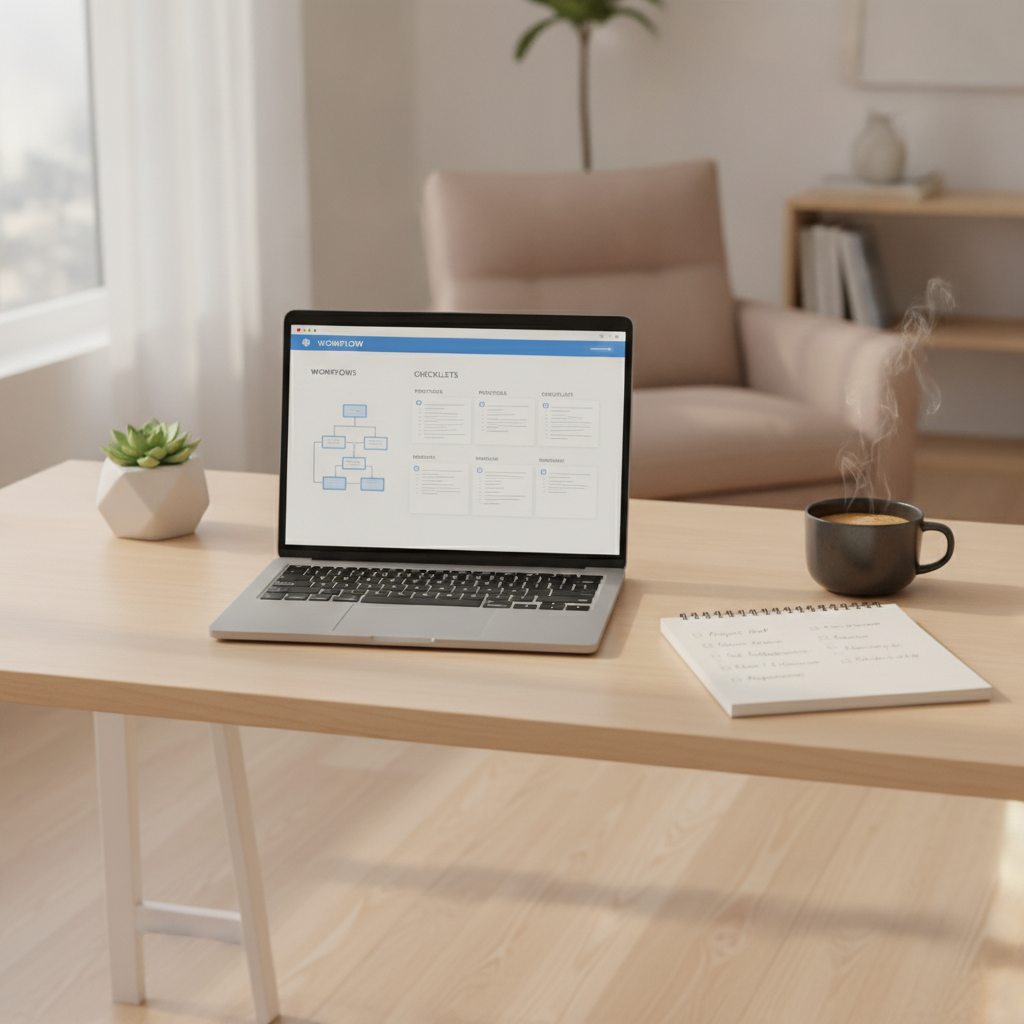
Clients do not want a raw folder of disconnected text files or markdown sheets. Your final deliverable should be an organised, searchable digital operations hub built directly inside the client's existing knowledge management workspace, such as Notion, Confluence, ClickUp, or Google Workspace. Delivering the work within the software their staff already opens every morning ensures the procedures actually get used rather than forgotten in an email attachment.
Every individual SOP in the hub should follow an identical structure: metadata indicating owner, department, and review frequency; an estimated completion time; a clear checklist for execution; and a troubleshooting guide for typical failures. You should also provide a single executive summary document and conduct a 45-minute handover review with the founder or operations lead. During this review, you walk through the system, confirm accuracy, and show them how their team will access and maintain the documentation.
What are the realistic unit economics and pricing tiers?
To build a sustainable service, price your packages based on business value and fixed scope rather than hourly rates. A practical entry package is a core department sprint covering 10 foundational procedures. For a boutique agency or trade business, you can charge £2,500 for this sprint. Delivering ten procedures typically requires 5 hours of client interview recordings, 4 hours of transcript processing and AI prompting, 4 hours of editorial refinement and formatting, and 2 hours for client review and handover, totalling 15 hours of labour.
Consider the operational maths: with 15 hours of total delivery time on a £2,500 contract, your effective gross hourly return is approximately £166.67 per hour. Software expenses for transcription APIs and LLM usage across 10 detailed procedures rarely exceed £20, leaving a gross profit margin of over 99% on direct tool costs. As you scale, you can offer an ongoing quarterly maintenance retainer at £600 per month, where you document two new workflows each month and update existing procedures as client tooling evolves. Managing four sprint clients and five retainer clients yields £13,000 in monthly revenue.
How do you find and close your first three SOP clients?
Your first clients will not come from passive social media posting; they come from identifying businesses currently feeling operational strain. Look for companies advertising multiple job openings on job boards. A business hiring five people across project management, account handling, and administrative support is preparing for a painful onboarding bottleneck. Their founders know that training these new hires without documentation will consume their own working weeks.
Reach out directly to the founder or operations director with a specific, low-friction offer. Instead of pitching a full operational overhaul, offer to document one single, frustrating, high-frequency process for free or a nominal fee of £150 as a proof of concept. Request a 20-minute screen recording of that workflow. Deliver a pristine, interactive SOP within 48 hours. Once they see the speed and quality of the output, converting them into a full ten-procedure sprint package becomes a straightforward commercial conversation.
What common pitfalls ruin an AI documentation service?
The quickest way to destroy client trust is delivering unverified AI output that contains hallucinations or missing context. Language models frequently smooth over vague spoken instructions by inventing logical-sounding steps that do not correspond to the client's actual software configuration. If an operator says 'then I send the invoice', an unguided model might write 'create an invoice in QuickBooks', even though the business uses Xero. You must personally review every step against the source recording.
Another critical failure is scope creep. If you agree to 'document our marketing process', the client may expect you to capture 30 micro-tasks, strategy guides, and copywriting rules. You must define a strict boundary at the contract stage: one SOP represents a single sequential task performed by one role from trigger to completion. By constraining each package to an agreed count of numbered workflows, you protect your margins and deliver projects on schedule.
What do people ask most about this?
Do I need deep industry knowledge of the client's business to write their SOPs?
You do not need specialised industry knowledge because your role is to capture, structure, and clarify their existing knowledge, not invent their strategy. The client provides the subject matter expertise through their spoken recordings and screen shares. Your value lies in operational listening, extracting clear logic, eliminating ambiguity, and formatting steps into an actionable framework. As long as you know how to ask clarifying questions about unclear transitions or missing permissions, you can document workflows across logistics, digital marketing, professional services, and trade businesses with equal competence.
Why would a business pay me instead of prompting an AI tool themselves?
Businesses pay you for the exact same reason they hire external accountants or cleaners: they lack the time, discipline, and systematic process to do it internally. Every business owner knows AI tools exist, but prompting an AI model is only 15% of the overall process. The hard work is collecting unstructured screen recordings from busy staff, managing the review cadence, verifying accuracy, eliminating hallucinations, and structuring everything inside a clean operational hub. You are selling an operational outcome that saves 40 hours of leadership time, not selling access to a chatbot.
Which software tools do you need to run an AI SOP creation service?
The necessary technology stack is lean and inexpensive. For recording, you need a subscription to an asynchronous video platform like Loom or a standard Zoom account. For transcription, you can use dedicated transcription services or Whisper-based tools that handle technical jargon accurately. For procedural structuring, a paid subscription to an advanced foundation model is essential for strong instruction-following and structured output. Finally, you need basic familiarity with common team knowledge bases such as Notion, Google Docs, ClickUp, or Confluence to deliver the final documentation directly into the client's environment.
How long does it take to deliver a 10-procedure documentation project?
A standard ten-procedure sprint can be completed comfortably within five to seven business days from the moment the client provides the raw recordings. Days one and two are spent conducting interviews or collecting screen captures and generating raw transcripts. Days three and four involve running extraction prompts, refining the generated procedures, and manually verifying system steps. Day five is dedicated to populating the client's knowledge hub and holding the final handover review. Because the turnaround is so rapid compared to traditional consultants, clients perceive immense value.
How was this article researched?
This article is written and maintained by Jim Vernon, Editor at AI Intelligence International. Figures and claims are drawn from the calculators and models published on this site, from vendor documentation current at the time of writing, and from first-hand testing of the tools described. Every article is reviewed against our editorial standards before publication and re-checked whenever the underlying tools or pricing change.