Developer & Tech
How Do You Implement Semantic Caching to Cut LLM Latency and Costs?
You implement semantic caching by converting incoming user queries into vector embeddings, storing previous query embeddings alongside their model responses in a fast vector database, and returning the cached response whenever a new query exceeds a cosine similarity threshold such as 0.92. This bypasses repetitive calls to costly frontier models, trimming token expenditure and reducing round-trip latency from several seconds down to tens of milliseconds.
When building generative software, traditional exact-string caching falls flat because users rarely type identical prompts. Small variations in punctuation, greetings, or phrasing bypass standard key-value stores like standard Redis setups. Semantic caching bridges this gap by evaluating the conceptual meaning of a prompt. Doing this safely, however, requires careful calibration of distance thresholds, an understanding of embedding costs, and deliberate cache invalidation policies.
By Jim Vernon, Editor, AI Intelligence International · Published 18 September 2026 · Reviewed against our editorial standards · About the author
What are the key takeaways?
- Exact string matching fails for language models because minor syntax shifts produce cache misses on conceptually identical queries.
- Similarity thresholds between 0.90 and 0.95 represent the practical sweet spot for balancing cache hit rates against misleading false positives.
- Embedding every inbound query introduces an infrastructure cost that pays for itself only when prompt volume and downstream model prices justify it.
- Dynamic context such as user identity, timestamps, and active sessions must be isolated from the semantic cache key to prevent data leaks.
What does this article cover?
| Question answered | How Do You Implement Semantic Caching to Cut LLM Latency and Costs? |
|---|---|
| Topic | Developer & Tech |
| Reading time | About 8 minutes (1,831 words) |
| Written by | Jim Vernon, Editor, AI Intelligence International |
| Published | 18 September 2026 |
| Last updated | 18 September 2026 |
What is semantic caching and why does exact matching fail?
Standard web applications rely on exact key-value caching where a hashed representation of the incoming request string maps directly to a stored response. In artificial intelligence applications, this conventional pattern yields disappointing results. Two users asking for the same refund policy might submit 'How do I get a refund?' and 'What is your returns and repayment policy?' While the intent is identical, their hash signatures share no common characters, causing an exact cache to trigger two separate full-price model inference cycles.
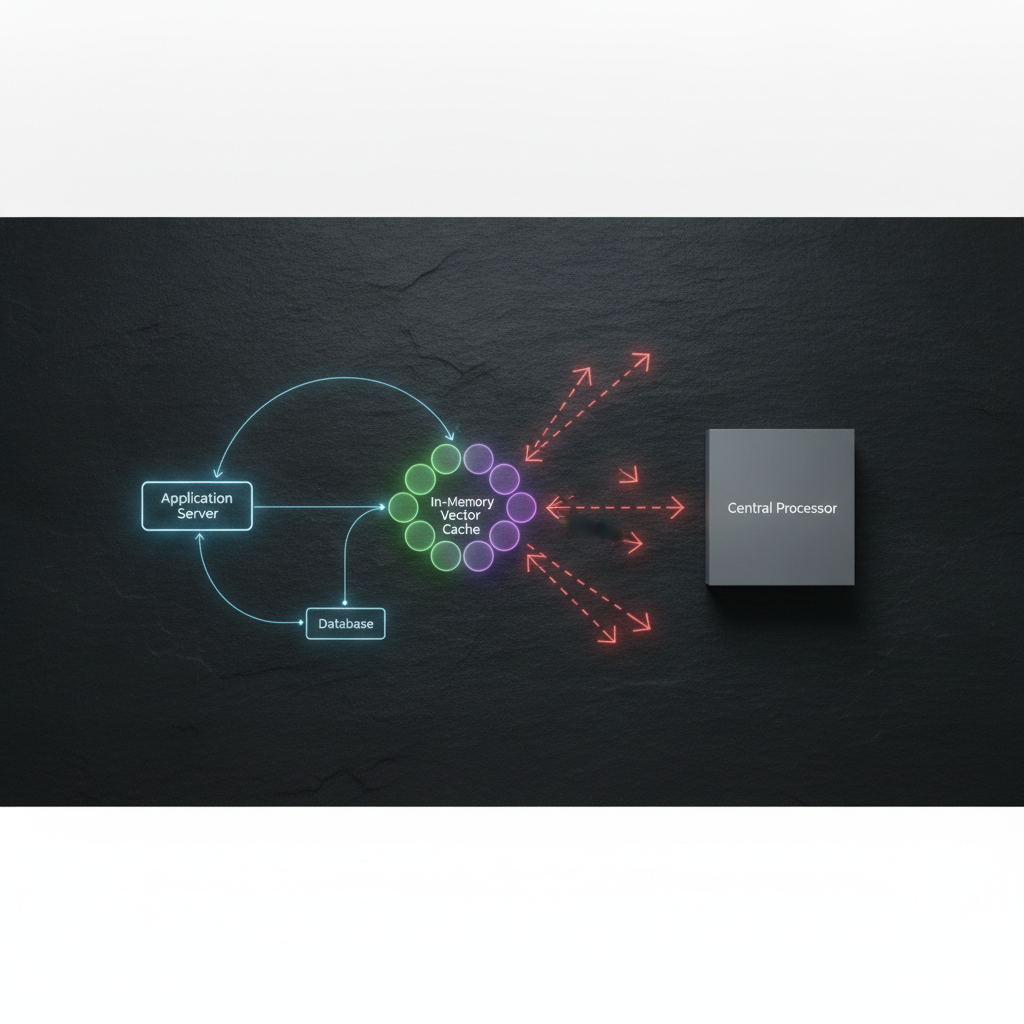
Semantic caching replaces rigid string keys with numerical vector embeddings that represent semantic intent. When an incoming prompt reaches your application gateway, an embedding model turns the text into an array of floats. Your cache layer compares this vector against existing keys stored in an in-memory index using cosine distance or dot product similarity. If a previous query sits within your designated mathematical tolerance, the gateway intercepts the call and serves the recorded response instantly.
This architectural shift changes the unit economics of shipping conversational agents and search systems. By decoupling repeated informational requests from frontier inference engines, you decouple user growth from linear token billing. You also insulate your users from upstream latency spikes and provider outages, as a significant portion of traffic resolves inside your own infrastructure layer.
How do vector similarity thresholds determine cache hits and misses?
The cosine similarity threshold is the single most critical configuration parameter in your semantic cache. If your threshold is set too low, say at 0.80, your system will suffer from false positives, returning answers to questions that merely sound similar but have fundamentally different operational meanings. For example, 'How do I cancel my plan?' and 'How do I upgrade my plan?' share substantial semantic context in billing vector spaces, yet returning a cancellation guide to a buyer wanting to upgrade damages the user experience.
Conversely, setting the threshold too high, such as 0.98, turns your semantic cache into an expensive approximation of an exact string cache. Real-world tests show that query phrasing variants typically converge between 0.90 and 0.94 cosine similarity when using current generation embedding models. In production, engineering teams often implement tiered thresholds based on intent classification. Factual product documentation can tolerate a 0.91 threshold, whereas account-specific or transactional prompts demand at least 0.96 or an outright cache bypass.
To calibrate your threshold systematically, extract a sample of one thousand historical user queries and run pairwise semantic comparisons. Label whether matching pairs represent identical user intent, then plot your precision and recall curves across different threshold values. Select the threshold that maintains a zero-tolerance baseline for destructive false positives while capturing the majority of natural conversational paraphrases.
Where in your application architecture should the cache sit?
A semantic cache belongs between your application business logic and your external model provider client, functioning as an intelligent reverse proxy or internal microservice. Placing the cache too close to the frontend client risks serving unauthenticated or stale responses without passing through necessary business checks. Placing it too deep inside individual background jobs leads to duplicate caching logic across services.
Your application layer should strip variable metadata before generating the query embedding. If a prompt includes system instructions, current timestamps, or user account IDs, you must split the prompt into dynamic context and core user intent. Only embed the core semantic intent for cache lookups. The recorded response can contain templated placeholders that your application hydrates with user-specific data before delivering the final payload to the client.
For the storage backend, managed in-memory stores with native vector search capabilities, such as Redis with RediSearch or specialized vector engines, provide the sub-ten-millisecond lookup speeds required. Relational databases running vector extensions can work at lower query volumes, but as concurrency climbs, dedicated in-memory vector indexing keeps retrieval latency well below model generation speeds.
What is the concrete financial break-even point for semantic caching?
Implementing semantic caching introduces its own infrastructure overhead: you must pay for embedding generation on every inbound request, alongside vector database hosting costs. Caching only saves money if these secondary operational costs remain substantially lower than the generative model tokens you avoid purchasing. Working through a concrete operational model clarifies this financial boundary.
Consider a customer support bot receiving 100,000 queries per day. The average prompt contains 250 input tokens, and the model produces an average answer of 350 output tokens. Using a standard production model priced at $2.50 per million input tokens and $10.00 per million output tokens, an uncached system costs $62.50 daily for input tokens (25 million tokens at $0.0000025) and $350.00 daily for output tokens (35 million tokens at $0.0000100), totaling $412.50 per day or $12,375.00 per 30-day month.
Now incorporate a semantic cache with an achievable 30 percent hit rate, meaning 30,000 requests are served from cache and 70,000 requests reach the model. Generating embeddings for all 100,000 queries using a model costing $0.02 per million tokens consumes $0.50 per day (25 million tokens at $0.00000002), or $15.00 monthly. Hosting an in-memory vector cache instance costs $70.00 monthly. The remaining 70,000 uncached queries generate $43.75 in daily input costs and $245.00 in daily output costs, totaling $288.75 per day or $8,662.50 monthly.
Adding the $8,662.50 model bill, $15.00 embedding expense, and $70.00 database fee yields a total monthly cost of $8,747.50. This represents a net saving of $3,627.50 each month, cutting the total inference bill by 29.3 percent. Crucially, the 30,000 cached requests drop from a 1,200-millisecond time-to-first-token down to a 25-millisecond cache delivery, providing a superior user experience alongside the monetary dividend.
How do you handle cache invalidation and prompt updates safely?
Cache invalidation remains one of the hardest problems in distributed systems, and semantic vector stores introduce additional complexity. Unlike an exact cache where clearing an item requires knowing its exact key, an updated product policy invalidates a cluster of conceptually related vectors scattered across your vector space. If you publish new return guidelines, any cached response reflecting the old policy must be purged immediately.
The most reliable invalidation pattern combines metadata tagging with time-to-live expirations. Whenever a response is cached, attach structured tags denoting the topical domain, the source document IDs used during generation, and the software version. When underlying business data changes, issue an invalidation command targeting all cache entries matching that specific metadata tag. Setting a default time-to-live of 24 to 72 hours on all semantic cache entries prevents abandoned or outdated answers from surviving indefinitely.
You must also account for changes in system prompts and model versions. When you modify your base application prompt or swap the underlying generation model, the tone and formatting requirements change. Include a hash of your active system prompt in the cache namespace or compound key metadata. When your engineering team deploys a prompt revision, update the namespace version so all subsequent queries naturally populate a fresh cache partition.
What security and data isolation risks must you prevent?
A naive semantic cache implementation creates severe data leakage vulnerabilities. If User A asks 'What is my current account balance and overdraft limit?' and the application caches the response, User B asking 'Can you check my balance and overdraft?' a minute later could receive User A's private financial figures if the threshold matches. Personal identifiable information must never enter a global semantic cache.
To neutralise this risk, maintain strict boundaries between global public caches and private user-scoped caches. Public documentation, product pricing, general onboarding guidance, and static catalog queries should be routed to a tenant-wide global cache. Any query requiring authenticated personal records, bespoke user state, or sensitive permissions must either bypass semantic caching altogether or be isolated behind a composite key that combines the user's encrypted tenant ID with the vector embedding.
Additionally, watch out for semantic cache poisoning attacks. Malicious actors who detect a semantic cache can deliberately submit adversarial prompts crafted to match common user queries while injecting subtle inaccuracies or harmful content into the response generation pipeline. Enforce strict output schema validation and moderate generated completions before writing them into the vector store to guarantee that only verified, safe completions become cached assets.
What do people ask most about this?
How does semantic caching differ from retrieval-augmented generation?
Retrieval-augmented generation searches external knowledge documents to assemble dynamic context, which is then fed into a language model to produce an entirely new response every single time. In contrast, semantic caching stores and returns the finalized model output directly based on query similarity, skipping model inference altogether. Many scalable production architectures use both techniques together: the semantic cache intercepts the incoming request first, and only upon a cache miss does the system execute a retrieval pipeline and downstream model call.
Which vector distance metric should I use for semantic caching?
Cosine similarity is the industry standard metric for semantic caching because it measures the directional angle between two vector embeddings rather than their magnitude, making it resilient to slight variations in token length. If you use normalized embeddings, inner product or dot product yields mathematically identical ranking results while requiring fewer floating-point operations per comparison, which slightly improves lookup latency across large vector indexes. Euclidean distance can also be used, but cosine similarity remains significantly easier to normalize and calibrate across diverse prompt lengths.
Can I use semantic caching with streaming LLM responses?
Yes, you can implement semantic caching with streaming responses, but you must alter your gateway architecture to buffer the stream. When an uncached query executes, your gateway streams chunks directly to the end user to preserve responsive time-to-first-token metrics, while concurrently accumulating the full string in a server-side buffer. Once the model finishes generating the complete completion, your background worker writes the accumulated text and query vector into your semantic cache store for future incoming queries.
How large can a semantic cache grow before vector lookups become slow?
A modern in-memory vector database using Hierarchical Navigable Small World indexing can comfortably search across several hundred thousand vectors in fewer than ten milliseconds. However, retaining millions of historic queries rarely provides economic value because conversational relevance decays over time. Implementing an aggressive least-recently-used eviction policy alongside a three-day to seven-day time-to-live keeps your index compact, typically under 100,000 active entries, ensuring query latencies remain consistently under five milliseconds without consuming excessive memory.
How was this article researched?
This article is written and maintained by Jim Vernon, Editor at AI Intelligence International. Figures and claims are drawn from the calculators and models published on this site, from vendor documentation current at the time of writing, and from first-hand testing of the tools described. Every article is reviewed against our editorial standards before publication and re-checked whenever the underlying tools or pricing change.