Developer & Tech
How Do You Chunk Documents for Vector Search Without Losing Context?
You chunk documents for vector search without losing context by splitting along semantic boundaries rather than arbitrary character counts, adding parent document metadata to every child chunk, and using recursive splitting that respects document hierarchy. Pair small chunks for vector matching with larger parent references for generation context.
Arbitrary chunking breaks sentences in half, severs table headers from row values, and drops the surrounding context that an embedding model needs to capture true semantic meaning. When your retrieval pipeline serves incomplete fragments to a language model, the system either hallucinates missing conditions or fails to find relevant information entirely. Designing an effective chunking strategy requires balancing embedding precision against context preservation.
By Jim Vernon, Editor, AI Intelligence International · Published 7 October 2026 · Reviewed against our editorial standards · About the author
What are the key takeaways?
- Semantic boundary splitting outperforms arbitrary character counts by preserving complete concepts within each vector embedding.
- A sliding window overlap of ten to twenty percent prevents topic fragmentation across adjacent chunk boundaries.
- Parent-child chunking decouples precise similarity retrieval from the broader context required for generation.
- Structured content like tables and source code must be treated as atomic units or parsed with specialised extractors.
What does this article cover?
| Question answered | How Do You Chunk Documents for Vector Search Without Losing Context? |
|---|---|
| Topic | Developer & Tech |
| Reading time | About 7 minutes (1,470 words) |
| Written by | Jim Vernon, Editor, AI Intelligence International |
| Published | 7 October 2026 |
| Last updated | 7 October 2026 |
Why does arbitrary character chunking degrade retrieval accuracy?
Most naïve retrieval pipelines use fixed-character splitters that sever text every five hundred or one thousand characters regardless of sentence structure. When a document is cut mid-sentence or mid-paragraph, the semantic vector calculated by the embedding model becomes noisy. A chunk that begins halfway through a conditional clause loses its antecedent, making it impossible for vector similarity search to match user queries that depend on the complete logical condition.
Furthermore, fixed-length chunking scatters contextual signposts across separate records. If an engineering manual defines a parameter on page three and specifies its failure thresholds in a table on page four, an arbitrary slice might place the parameter definition in one chunk and the numerical limits in another. The model retrieving those isolated chunks receives disconnected data points, leading directly to synthesis errors or retrieval misses in production applications.
How do you choose the right chunk size for your embedding model?
Embedding models are trained on specific context lengths, but cramming maximum tokens into a chunk dilutes retrieval sharpness. When an embedding vector represents an entire eight-hundred-word section, it captures the general topic of the text but smooths away granular facts, specific numbers, and niche terminology. Conversely, tiny chunks of fifty tokens match exact phrases well but lack the surrounding topical framework needed to establish relevance.
The practical standard for prose documentation sits between two hundred and fifty and five hundred tokens. This window provides enough semantic surface area for the embedding model to identify specific concepts while remaining tight enough to avoid vector dilution. You should always measure your document collection in tokens rather than raw character counts, because token density varies wildly between standard English prose, dense technical specifications, and structured code blocks.
How much chunk overlap do you actually need in production?
Chunk overlap acts as a bridge between adjacent text segments, ensuring that an important phrase or entity transition is not bisected by a boundary. However, excessive overlap inflates your vector database storage requirements, slows down ingestion pipelines, and wastes valuable generation context during retrieval. In production systems, an overlap between ten and twenty percent of the primary chunk size provides sufficient safety without creating unnecessary duplication.
Consider a concrete mathematical example using a technical library of five hundred reference manuals containing ten million raw tokens. If you implement a chunk size of 500 tokens with zero overlap, your corpus yields exactly 20,000 distinct chunks. If you instead configure a 15 percent overlap, which equates to 75 tokens per chunk, each subsequent chunk advances by 425 tokens. Dividing 10,000,000 tokens by 425 yields 23,530 chunks. Ingestion requires embedding 11,765,000 total tokens instead of 10,000,000, representing an overhead of 1,765,000 tokens or a 17.65 percent increase in database storage. In exchange for this predictable 17.65 percent storage overhead, you virtually eliminate boundary cut-offs for queries targeting transitional topics.
What is recursive structural chunking and how do you implement it?
Recursive structural chunking inspects the native syntax of a document and splits hierarchically down a list of separators until chunks fall within your target token budget. For standard Markdown documents, the parser first attempts to split by top-level section headings, then second-level headings, then double line breaks representing paragraphs, and finally individual sentences. The parser never breaks a paragraph if the entire paragraph fits neatly into the target window.
By respecting structural boundaries, recursive chunking ensures that complete units of thought stay intact. If an author grouped three sentences under a single sub-heading to explain a policy change, those three sentences remain together within a single vector. You should also inject document-level metadata, such as the document title and the active heading path, into the prefix of every generated chunk so the embedding model retains topical grounding even when reading deeply nested sub-sections.
How does parent-child retrieval solve the context tradeoff?
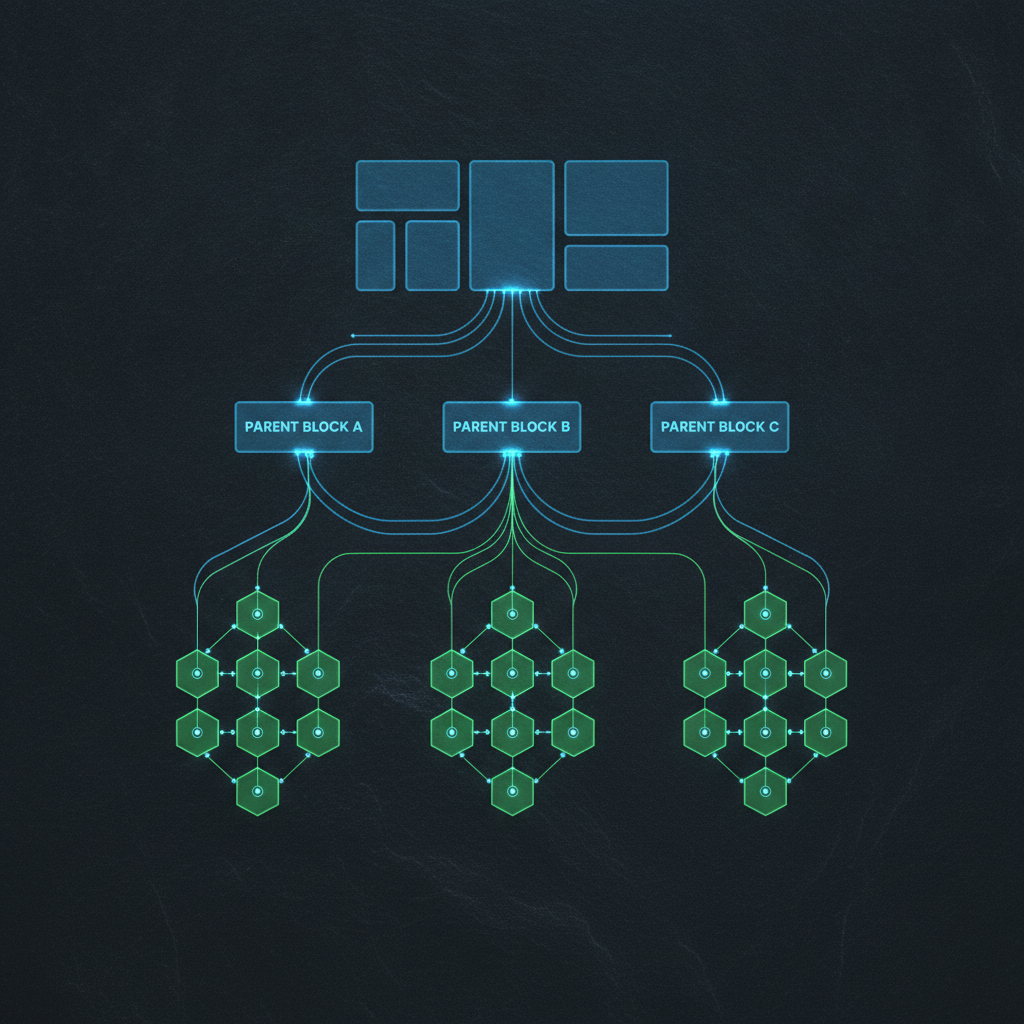
Engineering teams often face a dilemma: small chunks deliver high retrieval precision, but large chunks give the language model enough context to write comprehensive answers. Parent-child retrieval resolves this tension by indexing two different representations of the same source text. You divide documents into large parent chunks of one thousand to fifteen hundred tokens, and then subdivide each parent into multiple child chunks of two hundred tokens.
During ingestion, you generate embeddings exclusively for the smaller child chunks, but you store a reference key pointing back to the parent block. When a user submits a query, the vector database matches against the granular child embeddings to achieve pinpoint retrieval accuracy. Before calling the generative model, your application swaps the retrieved child IDs for their corresponding parent blocks, providing the model with complete surrounding context without compromising search relevance.
How do you handle tables, code snippets, and structured data?
Tabular data and source code fail catastrophically under standard text splitters. A table split across rows loses its column definitions, turning numerical values into meaningless isolated strings. When chunking documents containing tables, you must treat each table as an atomic unit whenever possible. If a table exceeds your chunk limit, parse it into structured JSON objects or transpose it into markdown rows where every row repeats the explicit column header names.
For programming code, implement syntax-aware splitting using abstract syntax trees rather than character splits. Tools like Tree-sitter allow you to split source code by function, class, or module declarations. Preserving syntactic boundaries prevents broken brackets, isolated imports, or orphaned variable declarations, ensuring that code search returns viable, executable context rather than syntactically invalid fragments.
How do you test and evaluate your chunking strategy?
You cannot optimise chunking purely by intuition; you must establish automated retrieval evaluations before deploying updates to production. Construct a synthetic evaluation benchmark comprising fifty to one hundred representative questions mapped to the exact source paragraphs required to answer them. Measure mean reciprocal rank and hit rate across varying chunk sizes and overlap configurations to identify the point where retrieval accuracy peaks.
Watch out for silent degradation where high retrieval scores mask synthesis failures. If your search engine retrieves the correct chunk but the final answer omits key constraints, your chunk is likely too small to contain the qualifying context. Running systematic evaluations across baseline character splitting, recursive splitting, and parent-child architectures will demonstrate precisely which approach delivers optimal grounded answers for your specific documentation corpus.
What do people ask most about this?
What is the difference between fixed-size and semantic chunking?
Fixed-size chunking splits raw text at uniform character or token intervals regardless of punctuation, structure, or logical meaning. Semantic chunking analyses linguistic cues, sentence endings, or embedding similarity between adjacent sentences to divide documents along thematic boundaries. While fixed-size chunking runs faster and uses minimal compute during preprocessing, semantic chunking consistently delivers superior retrieval accuracy because each chunk encapsulates a coherent concept, preventing fragmented definitions and incomplete context in production search indexes.
How do you preserve metadata across document chunks?
Preserve metadata by extracting global document attributes such as author, publication date, URL, and category during the initial parsing phase and appending them to each chunk record. Additionally, track structural hierarchy by maintaining a breadcrumb trail of markdown headers. Prepending this hierarchical header string directly to the chunk text ensures that embedding models understand the scope of nested paragraphs, while storing attributes in database metadata fields enables precise pre-filtering during vector queries.
Does increasing chunk overlap improve retrieval performance?
Increasing chunk overlap improves retrieval performance only up to a threshold of roughly twenty percent, beyond which returns diminish rapidly. A modest overlap prevents critical phrases from being split across boundaries, helping the search index locate concepts that span transitions. However, overlaps exceeding twenty-five percent introduce duplicate information, bloat vector storage, increase embedding ingestion expenses, and waste generation window capacity by retrieving repetitive content.
When should you use parent-child chunking instead of single-tier chunks?
You should use parent-child chunking when your users ask specific, factual questions that require broad topical context to answer accurately. In technical documentation, regulatory manuals, and legal contracts, the exact sentence that matches a user query often depends heavily on overarching conditions defined paragraphs earlier. Parent-child architectures allow small child chunks to handle precise semantic matching while retrieving larger parent blocks to supply the language model with full explanatory context.
How was this article researched?
This article is written and maintained by Jim Vernon, Editor at AI Intelligence International. Figures and claims are drawn from the calculators and models published on this site, from vendor documentation current at the time of writing, and from first-hand testing of the tools described. Every article is reviewed against our editorial standards before publication and re-checked whenever the underlying tools or pricing change.