Productivity
How Do You Build an AI Research Synthesis Workflow That Actually Saves Time?
To build an AI research synthesis workflow that genuinely saves time, you must decouple data extraction from narrative synthesis, process source texts in structured chunks using rigid extraction schemas, and verify citations before drafting. Treating an AI model as an analytical processor rather than an open-ended writer prevents hallucinations and creates an audit trail back to raw source notes within minutes.
Most knowledge workers waste hours because they dump fifty pages of uncurated notes into a large language model and ask for an executive summary. The output usually feels plausible yet ends up superficial, requiring another two hours of manual cross-checking to verify facts, missed caveats, and invented sources.
By Jim Vernon, Editor, AI Intelligence International · Published 27 September 2026 · Reviewed against our editorial standards · About the author
What are the key takeaways?
- Decoupling factual extraction from final report drafting cuts verification time by more than half.
- A structured tabular schema forces models to cite exact phrases and paragraph locations rather than inventing summaries.
- Chunking reference documents into discrete analytical units prevents the lost-in-the-middle context degradation common to long-window models.
- Human verification belongs strictly at the extraction boundary, not at the end of the narrative drafting process.
What does this article cover?
| Question answered | How Do You Build an AI Research Synthesis Workflow That Actually Saves Time? |
|---|---|
| Topic | Productivity |
| Reading time | About 6 minutes (1,312 words) |
| Written by | Jim Vernon, Editor, AI Intelligence International |
| Published | 27 September 2026 |
| Last updated | 27 September 2026 |
Why does raw document dumping fail when synthesising research?
When you dump multiple long documents into a single prompt and ask for a synthesis, you trigger two predictable failure modes. First, attention heads in transformer models exhibit positional bias, frequently glossing over nuances tucked away in the middle third of long prompts. You receive an answer dominated by the introductory paragraphs and the conclusion of your uploaded files, while technical contradictions buried midway remain unaddressed.
Second, asking a model to extract facts and write polished prose simultaneously overloads its generative focus. The model prioritises linguistic coherence and narrative rhythm over strict empirical fidelity. It smooths over discrepancies between sources, invents connective tissue that sounds reasonable, and quietly fabricates supporting claims to maintain paragraph flow. You end up with a smooth, beautifully written report that contains foundational errors you cannot safely publish or share with stakeholders.
How should you structure the initial extraction step?
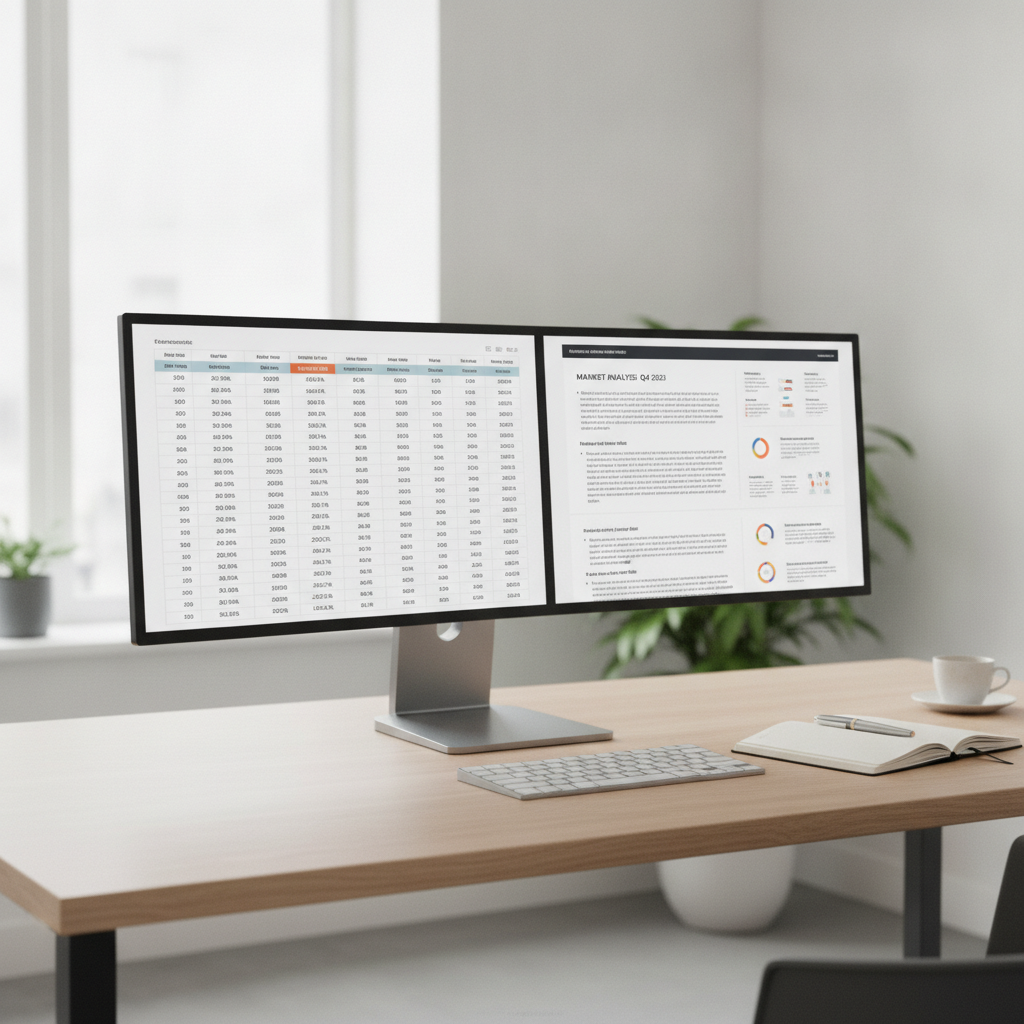
The foundation of a reliable synthesis workflow is strict information extraction before any summary writing begins. Instead of asking for conclusions, feed your raw source documents individually into your chosen language model and mandate a fixed output schema. You want structured, atomic facts, not prose paragraphs. Instruct the model to return a structured table containing four explicit columns: the core claim, the supporting metric or data point, an exact verbatim quotation, and the source document identifier.
By restricting the model to transcription and tabular mapping, you remove its mandate to fabricate narrative bridges. If a source document does not contain an answer to an extraction field, instruct the model to output a null value explicitly rather than guessing. Reviewing a 20-row table for factual accuracy takes less than five minutes because you can match verbatim quotes directly against the original text using simple keyword searches.
What does a multi-source comparative matrix look like?
Once you have extracted structured data tables from each source document, combine them into an aggregated comparative matrix. This step gathers disparate perspectives into a single unified analytical schema. Your matrix maps key themes, contradictory findings, shared assumptions, and outlier metrics across all reviewed materials.
At this stage, you ask the model to act as a comparative analyst rather than a researcher. Provide the combined tabular extracts and prompt the model to identify direct agreements, explicit disagreements, and methodological differences. Because the model operates exclusively on pre-verified extracts rather than thousands of words of unstructured prose, its attention remains focused on logical relationships rather than document retrieval. This guarantees that conflicting findings between competing vendors, financial reports, or technical specifications become visibly highlighted rather than erased.
What is a worked example of time and cost savings with structured synthesis?
Consider a senior product strategist reviewing four technical vendor evaluations, running 25 pages each, totalling 100 pages or roughly 40,000 words. Reading, cross-referencing, and manually drafting an eight-page comparative synthesis traditionally takes approximately 6 hours of focused work. An unguided AI pass taking 15 minutes creates an inaccurate draft that requires 3.5 hours of painstaking line-by-line verification, yielding a net saving of only 2.25 hours alongside high cognitive fatigue.
Under a structured synthesis workflow, the strategist runs four separate extraction prompts taking 2 minutes each, reviewing the tabular output against source pages in 20 minutes total. Compiling the four tables into a comparative matrix prompt takes 5 minutes, producing an audited theme map in 2 minutes. Generating the final synthesis from that verified matrix takes another 5 minutes, followed by 30 minutes of stylistic editing and polish. Total elapsed human effort is 62 minutes (1.03 hours). At a consultant billing rate of £90 per hour, the manual workflow costs £540 of billable time, the messy AI pass costs £337.50, and the structured workflow costs £92.70, saving £447.30 and 4.97 hours per report with zero hallucination risk.
How do you prompt the model to generate the final narrative synthesis?
Drafting the final narrative only happens once your extraction matrix passes verification. In your final generation prompt, feed the verified matrix into the context window as your sole ground truth. Instruct the model that every analytical claim must cite the specific row identifier from your extraction table. If a point cannot be substantiated by the provided matrix rows, the model must omit it entirely.
Provide clear editorial guidelines for tone, structural headings, and target length. Direct the model to explicitly flag contradictions surfaced in the matrix rather than harmonising them. For example, specify that if Source A claims a 15% efficiency gain while Source B finds an 8% loss under identical test conditions, the draft must contrast both findings side by side. This produces an authoritative, nuanced document ready for executive review with minimal line editing.
How can you audit and stress-test the finished document for hallucinations?
Before distributing the synthesis, execute a reverse audit step using a fresh context window. Paste your final generated narrative alongside your extracted data table and ask the model to perform a discrepancy analysis. Instruct it to flag any metric, date, causal claim, or named entity in the prose that lacks an explicit antecedent in the source table.
This automated consistency check catches latent drift where the model may have reintroduced generic corporate generalisations during narrative drafting. Combining automated reverse auditing with a human spot-check on key numerical boundaries ensures absolute fidelity. You retain the velocity of automated text generation without carrying the legal, reputational, or commercial risk associated with unsupervised model output.
What do people ask most about this?
How long should each document chunk be when feeding sources into the workflow?
Aim to chunk long materials into sections of roughly 2,000 to 4,000 words before running your extraction prompts. While modern frontier models feature context windows extending to hundreds of thousands of words, empirical accuracy and retrieval density degrade significantly as token counts climb. Feeding focused chapters or thematic sections individually forces high-fidelity extraction, prevents retrieval drop-off, and makes it trivial for you to spot-check source citations against specific passages.
Which model class works best for extracting structured data from messy research?
High-reasoning frontier models with strong instruction-following capabilities excel at the extraction phase, whereas faster, lower-cost models can handle the final narrative drafting once given a tight tabular schema. Prioritise models that support native structured outputs such as JSON mode or enforced schema validation. This ensures the output maintains rigorous tabular boundaries without breaking into conversational chatter that disrupts your downstream pipeline.
Can this workflow handle quantitative data and spreadsheets alongside text?
Yes, provided you convert quantitative tables into Markdown or CSV format before inclusion. Language models process structured delimited text far better than raw binary files or complex PDF table layouts. Include the units of measurement and time periods directly within each row of your extraction schema. This prevents the model from conflating fiscal quarters, annualised returns, or competing metric scales during comparative synthesis.
How do you handle confidential business documents safely within this process?
Ensure your organisation utilises enterprise API agreements or workspace tiers that legally prohibit vendors from training models on your inputs. If using commercial chat interfaces, disable data retention and training toggles within your account settings. For highly sensitive intellectual property, proprietary financial records, or regulated healthcare data, deploy open-weight models locally on dedicated hardware to ensure zero data leaves your private network.
How was this article researched?
This article is written and maintained by Jim Vernon, Editor at AI Intelligence International. Figures and claims are drawn from the calculators and models published on this site, from vendor documentation current at the time of writing, and from first-hand testing of the tools described. Every article is reviewed against our editorial standards before publication and re-checked whenever the underlying tools or pricing change.